The How-to Book of the Mass by Michael Dubruiel not only provides the who, what, where, when, and why of the most time-honored traditions of the Catholic Church, but also the how. All in an easy-to-read, easy-to-understand format.
Saturday, July 20, 2024
Eucharistic Congress 2024
Friday, July 19, 2024
Eucharistic Congress 2024
The How-to Book of the Mass by Michael Dubruiel not only provides the who, what, where, when, and why of the most time-honored traditions of the Catholic Church, but also the how. All in an easy-to-read, easy-to-understand format.
The Road to Emmaus:
As we look at the various parts of the Mass, we will pause to meditate on this story from Luke's Gospel. I expect that you will come to finnd in this Gospel story an excellent tool to help you refocus yourself on Christ at the various moments of every Mass you attend. I have written this book with all Catholics in mind. Whether young or old, male or female, liberal or conservative — In Christ we are one, at Mass we are one, one Body: Jesus'.
I hope to help you rediscover the Mass as a vehicle for letting go of all that can seem to separate you in life, and to replace what seem like distractions with the deep, meaning-filled events of your daily life. Rediscover the Mass as a way to open the wounds, the scars, the needs that Jesus can heal, and to encounter the very Lord Himself, so you might leave every Mass with His peace and a deep sense of unity with God and your fellow man.
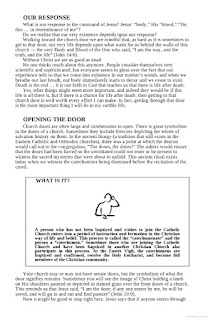
A sample page:
Thursday, July 18, 2024
Eucharistic Congress 2024
The Eucharistic Congress continues in Indianapolis.
If your are interested in deepening your appreciation and understanding of the Eucharist, How to Get the Most Out of the Eucharist by Michael Dubruiel.
SACRIFICE.
Filled with stories, solid prayer-helps, and sound advice, HOW TO GET THE MOST OUT OF THE EUCHARIST shows you how to properly balance the Mass as a holy banquet with the Mass as a holy sacrifice. This books guides readers to embrace the Mass as the most powerful way to grow in their relationship with Jesus Christ.
Wednesday, July 17, 2024
Eucharistic Congress 2024
The Eucharistic Congress begins today, July 17, in Indianapolis.
If your are interested in deepening your appreciation and understanding of the Eucharist, consider The Pocket Guide to the Mass by Michael Dubruiel.
Get the most out of the Mass...
A Pocket Guide to the Mass walks you through the biblical basis of prayers, the meaning behind gestures, and a brief overview of the spirituality that brings Catholics together for Eucharist each week.
Reenergize your time at Mass or help those who are new or returning to the Church with this quick and insightful overview. Rediscover the fullness of the Mass today!
Tuesday, July 16, 2024
Eucharistic Congress 2024
The Eucharistic Congress begins tomorrow, July 17, in Indianapolis.
If your are interested in deepening your appreciation and understanding of the Eucharist, consider The How To Book of the Mass by Michael Dubruiel:
Maybe you are a recent convert, or perhaps you've attended Mass your whole life, but there are still things that puzzle you, like: when you should genuflect and when you should bow; what the different books used at Mass are and what they contain; the meaning of words like "Amen," "Alleluia," or "Hosanna"; what to do during the sign of peace.
You aren't alone.
The How-to Book of the Mass not only provides the who, what, where, when, and why of the most time-honored traditions of the Catholic Church, but also the how. All in an easy-to-read, easy-to-understand format.
In this complete guide to the celebration of the Eucharist you get:
- Step-by-step guidelines to walk you through the Mass
- Biblical background of the prayers of the Mass
- Insights from the Tradition and teaching of the Church
- Practical aid to overcoming distractions
- Concrete ways to grow in your relationship with Jesus Christ at every Mass
- A handy study guide for individual or group use
Includes 2011 Roman Missal Translation changes.
Monday, July 15, 2024
St. Bonaventure July 15
From The Universalis: Office of Readings:
"Christ is both the way and the door. Christ is the staircase and the vehicle, like the throne of mercy over the Ark of the Covenant, and the mystery hidden from the ages. A man should turn his full attention to this throne of mercy, and should gaze at him hanging on the cross, full of faith, hope and charity, devoted, full of wonder and joy, marked by gratitude, and open to praise and jubilation. Then such a man will make with Christ a pasch, that is, a passing-over. Through the branches of the cross he will pass over the Red Sea, leaving Egypt and entering the desert.
There he will taste the hidden manna, and rest with Christ in the sepulchre, as if he were dead to things outside. He will experience, as much as is possible for one who is still living, what was promised to the thief who hung beside Christ: Today you will be with me in paradise.
For this passover to be perfect, we must suspend all the operations of the mind and we must transform the peak of our affections, directing them to God alone. This is a sacred mystical experience. It cannot be comprehended by anyone unless he surrenders himself to it; nor can he surrender himself to it unless he longs for it; nor can he long for it unless the Holy Spirit, whom Christ sent into the world, should come and inflame his innermost soul. Hence the Apostle says that this mystical wisdom is revealed by the Holy Spirit.
If you ask how such things can occur, seek the answer in God?s grace, not in doctrine; in the longing of the will, not in the understanding; in the sighs of prayer, not in research; seek the bridegroom not the teacher; God and not man; darkness not daylight; and look not to the light but rather to the raging fire that carries the soul to God with intense fervour and glowing love. The fir is God, and the furnace is in Jerusalem, fired by Christ"
Books by Michael Dubruiel
Sunday, July 14, 2024
Michael Dubruiel: 73 Steps to Spiritual Communion with God - 16b
This is a continuation of the 73 Steps to Spiritual Communion with God by Michael Dubruiel. The previous are posted below among the other posts and last week's archives. Here is the sixteenth step, part two:
(16) To visit the sick (cf Mt 25:36).
I have visited the sick many times in my life, usually out of obligation. The reluctance, and hesitation to set out on those journeys remains. It seems that we are reluctant to meet a side of the other that we fear to meet within ourselves. We fear seeing ourselves as we really are.
Visiting the sick is a holy activity. We should bring the healing of Christ to those who are ill, and we should commend them to our prayers, as well as asking their prayers.
Saturday, July 13, 2024
Michael Dubruiel: 73 Steps to Spiritual Communion with God - 17
This is a continuation of the 73 Steps to Spiritual Communion with God by Michael Dubruiel The previous are posted below among the other posts and last week's archives. Here is the seventeenth step:
(17) To bury the dead.
The most vivid memories I have of monastic life are actually those dealing with how the dead our buried. I have witnessed these events at several types of monasteries and while the particulars differ, they all share the common denominator of being terribly comfortable with a dead body.
I remember visiting a Trappist Monastery with a friend once who had never witnessed a dead body before. Somehow she had spent over 40 years on this earth without ever having been to a funeral or grave site. Protected from death by her parents, she had not bothered to confront it as an adult either. Until the fateful day when she stumbled upon it, on a visit for Evening Prayer at the monastery. Talk about shock therapy!
We were sitting toward the back of the Abbey Church with the rest of the non-monks. The monks themselves were gathered at the door awaiting the arrival of the body of their brother monk. Upon its arrival it was placed on a flat surface (no coffin) and brought forward a few feet, with the help of several feeble monks to stop a few inches from where my friend and I stood.
The pallor of the dead body, its lifeless shell spoke of the finality of the event. I’m sure my friend still wakes up in the middle of the night with the vision of that moment.
I had seen death many times before. I had even been blessed to be with several people at the moment of death, hearing their last breath escape, watching their eyes go up and out their head, giving me an understanding of why the ancients believed that the soul came in from the top of the head and when it left a body escaped from the same portal.
In some ways the moment of death can be likened to something of a whimper. It seldom is the drawn out affair of the actor who tries by their exaggerations to communicate the tragedy of what is unfolding. While birth may take hours, death often needs only the hundredth of a second.
The Trappist bury their dead by dumping the body into a grave and throwing some lime over the corpse to aid in the decaying process. The Benedictines that I have known, use a simple pine box. Both end their funeral rites by individually throwing dirt either onto the corpse or coffin—thereby fulfilling this counsel of St. Benedict to bury the dead.
Two images come to mind. The first of my friend who for over forty years had never witnessed a dead body. The second of the monks throwing dirt on the remains of their dead brother. I wonder what is the effect on both.
My friend is symbolic of those who in our present culture seek to keep death at a distance. Someone dies, we cremate the body and someone scatters ashes in the same way that a past generation might have emptied an ashtray.
This same culture visualizes death constantly in its movies and music. It seems that if we do not bury the dead that the effect on us is that we will endlessly be haunted by them.
The monks are not haunted by the dead but they are not abandoned by them either. They see in the brother who has passed from this life leaving behind the shell of their body and example. It reminds them of their purpose and the shortness of the opportunity to fulfill this purpose. They are reminded by death that ultimately all that matters is God!
Burying the dead may be as simple as attending the funerals of our friends and families. Praying for them and asking their prayers. The uneasiness that we feel is due to the inner knowledge that this to will be our end but like every unpleasant truth in life we can either face it or try to ignore it.
Friday, July 12, 2024
Michael Dubruiel: 73 Steps to Spiritual Communion with God 16a
This is a continuation of the 73 Steps to Spiritual Communion with God by Michael Dubruiel. The previous are posted below among the other posts and last week's archives. Here is the sixteenth step, part one:

(16) To visit the sick (cf Mt 25:36).
The difficulty in visiting the sick is usually not their illness but rather something within ourselves that likes to hide from our own mortality. The sick too often remind us of the shortness of our own life and the transitory nature of our pilgrimage on this earth.
I remember as a young man that I would visit a young woman in a nursing home and bring her communion once a week. She was a few years older than I was at the time but was dying of terminal cancer. All of her hair had been shaved and she often wore a wig to hide the fact.
At first the smells of the nursing home and the lingering feeling of death, made the short trip to the nursing home a very difficult one for me to make. I would often speak to the young woman, whose name was Pearl, about the possibility of healing etc.—I realized all of which made me feel better—she just brushed off these comments.
Our conversations were often one sided even though we spoke to each other. She confessed that until she had been ill that she had not thought much about God, and claimed to have been a magnificent sinner. Once she even pulled out a photo of her before the cancer, only a few years before, that showed a vivacious beautiful woman laughing with her friends. Now clutching a crucifix, her constant companion in her bed of pain she smiled and said that she had accepted death.
I will never be able to measure the effect that my weekly visits with Pearl have had on my life or for that matter what continued influence she has on my life even now. Only in Heaven can I hope for a true accounting of this. But I do know that the image of her in her bed of pain clutching that crucifix remains with me even now. Like a mirror held up to the moments of my life—each event is measured by how well I use my time here.
More by Michael Dubruiel.
Thursday, July 11, 2024
July 11- Feast of St. Benedict
This is a continuation of the 73 Steps to Spiritual Communion with God based on the Rule of St. Benedict by Michael Dubruiel. The previous posts are below and in the archives to the right. This is the 28th step:
(28) To speak the truth with heart and tongue.
St. Benedict's counsel here is geared toward a conversion of feelings, so that the truth I speak with my mouth, I also feel in my heart. Of course, such truth will be spoken with conviction.
Many of us know instinctively what is true, we just don't feel like paying any attention to it. Conversion of "feelings" is an important part of opening oneself to God.
If you don't feel like converting to the truth, it is because some untruth has grabbed your heart. Opening your heat to God's love will have a surprising result--you will literally feel the truth.
Too often we look toward those who should model religious faith but instead wear their faith for all to see. Jesus condemns the Pharisees and hypocrites of his day because they keep the tax collectors and prostitutes from coming to the Kingdom of God by their example. In other words they make religious belief in God seem unattractive.
Our eyes should always be focused on Christ. We shouldn't look to anyone else.
The people who encountered Him were drawn to Him. So will we be.
Wednesday, July 10, 2024
73 Steps to Spiritual Communion with God 15b
This is a continuation of the 73 Steps to Spiritual Communion with God by Michael Dubruiel. The previous are posted below among the other posts and last week's archives. Here is the fifteenth step part two:
(15) To clothe the naked...
I have worked in a clothing closet before. Handing out clothing to the homeless. They would come in on Saturday mornings about 30 minutes before the soup kitchen would start serving food and would tell you what they needed.
“I need a shirt, extra large. Something in dark colors.”
I would go to the rack of men’s clothing and look for something that fit that description. Often the item would be an expensive shirt donated by someone who no longer felt it fashionable enough for their taste. Hardly ever was the clothing in any form of disrepair.
The poor man would usually snatch the piece of clothing from my hand and look at it before grunting and moving onward toward the kitchen. Some would thank me, many would avoid looking at me in the eye—embarrassed, only once did someone ask for the shirt that I was wearing—which I wish I could say that I had given to them.
None of the people I handed clothing to were ever naked.
So who are these “naked” that we are to clothe?
Tuesday, July 09, 2024
Michael Dubruiel: 73 Steps to Spiritual Communion with God 15a
This is a continuation of the 73 Steps to Spiritual Communion with God by Michael Dubruiel. The previous are posted below among the other posts and last week's archives. Here is the fifteenth step part one:

(15) To clothe the naked...
For some reason the first thing that comes to mind when confronted with this counsel of St. Benedict is something that I read some years ago in a work by Peter Brown in a book entitled The Body and Society: Men, Women and Sexual Renunciation in Early Christianity -a book that among other things, looks at early Christianity’s view of the body. Brown speculates that the Church’s view of modesty in the Roman World is colored by the fact that nudity was the privilege of the wealthy.
Another thought that comes to mind, is the way in which Baptisms were done in the early church. The catechumen would strip naked leaving the clothing they entered the church with behind, as they entered the Baptismal pool and then as they emerged from the waters and had oil poured over their heads, they would be clothed in a new garment.
The young man in Mark’s Gospel (Mk 14:52) who fleas the scene of the arrest of Jesus naked, is another image that comes to mind. Whereas the apostles had left everything to follow Jesus, now at the crucial moment of decision this young man (thought by some to be the writer of the Gospel--Mark) leaves everything behind to get away from Jesus.
But it could be that this young man’s presence in the Gospel is also an indication of the early Church’s Baptismal practice. When you understand how Baptisms were done, and also what entering the waters of Baptism symbolizes (entering into the Death and Resurrection of Jesus) you will see the connection between the young man leaving his clothes behind and then reappearing after the Passion in the Empty Tomb, (in place of the Angels who are there the other Gospels).
Monday, July 08, 2024
Michael Dubruiel: 73 Steps to Spiritual Communion with God 14a
This is a continuation of the 73 Steps to Spiritual Communion with God by Michael Dubruiel The previous are posted below among the other posts and last week's archives. Here is the fourteenth step part two:
(14) To relieve the poor.
Others came to the door looking for food of a different sort.
Thomas Merton in Bread in the Wilderness speaks of the psalms as God’s manna, given to feed the soul in the desert of life. The monk’s prayer, made up almost entirely of praying the psalms, provided that nourishment for many who had suffered loss or hurt from great struggles of faith.
All of us are poor. It is arrogant to think that I am somehow better than anyone else. If there is anything that I have hated throughout my life, it is those who look down on others. Sadly, it is also the part of myself that I hate the most—and the part that I know could ultimately condemn me if I do not let go of it.
Saint Benedict did not leave counsel to “help” the poor, even though we could interpret this counsel as concretely doing this. He told them to breathe life into them.
I could feed the poor with food, but if I made them feel like I was doing them a great service, I could leave them with their bellies full but still feeling very poor. If on the other hand, I fed them in the way I might some friend who I hoped to impress and win favor from, how might that leave them?
The famous, the wealthy and those in power often find that doors are opened for them and everything provided for them, although they usually have done nothing to deserve it. We may not have a “royal” family in this land of ours, but some are treated that way nonetheless. Why should some be treated that way and while others are neglected?

Sunday, July 07, 2024
Michael Dubruiel: 73 Steps to Spiritual Communion with God - 13c
This is a continuation of the 73 Steps to Spiritual Communion with God by Michael Dubruiel. The previous are posted below among the other posts and last week's archives. Here is the thirteenth step part three:
(13) To love fasting.
I am not talking about dieting here, but I am talking about an attitude adjustment. A metanoia, “a complete turning around”, is what is necessary here. Years of being told we need more and more have left us unsatiated no matter how much we have acquired or have placed before us.
Saturday, July 06, 2024
Michael Dubruiel: 73 Steps to Spiritual Communion with God - 13b
This is a continuation of the 73 Steps to Spiritual Communion with God by Michael Dubruiel. The previous are posted below among the other posts and last week's archives. Here is the thirteenth step part two:
(13) To love fasting.
Friday, July 05, 2024
Michael Dubruiel: 73 Steps to Spiritual Communion with God - 13a
This is a continuation of the 73 Steps to Spiritual Communion with God by Michael Dubruiel. The previous are posted below among the other posts and last week's archives. Here is the thirteenth step part one:
(13) To love fasting.
Most of us are not familiar with fasting, but we are with dieting. They are not the same thing. Dieting has to do with vanity, fasting has to do with a higher good. We all feel so many needs that are not real but remain unaware. Fasting is a traditional means of gaining the wisdom of what we truly need.
Notice that St. Benedict’s counsel is not simply to “fast” but rather to “love” fasting. He wishes that the monk’s desire be-- to do without.
I am reminded of an old distinction made by Archbishop Fulton Sheen on his Life is Worth Living series. We have little choice over what we like, but love is an act of the will. We can choose to love something and we usually do learn to love both things and people that initially we may not have liked. We can also learn and choose to hate.
In a society such as ours fasting happens often enough but not for it’s own sake. People traveling or involved in work regularly skip meals for the sake of whatever has their focus. The problem is that in the long run we tend to be like camels and when we do sit down to eat, we gorge ourselves in case it might be awhile before we set down again.
Thursday, July 04, 2024
Accidently Like a Catholic - The Warren Zevon Story

(Michael Dubruiel died less than 2 years after writing this post.)
My introduction to Warren Zevon came in the early 1980's when I was in a record store in Gainesville, FL looking for a new album that had just came out (I don't remember what the album was). While in the store I was caught up with the album they were playing over the PA system..a singer was singing about being in Hawaii and abandoned by his girl to the "Hula, Hula" boys with a refrain in Hawaiian. It piqued my interest. I listened on to the next song which was about going to Memphis, Graceland to be exact and digging up the king and begging him to sing about those heavenly mansions Jesus mentioned and imagining him (Elvis) walking on the water with his diet pills.
I was hooked.
Who was the artist? I asked the guy at the counter.
Warren Zevon.
The album?
The Envoy
I became a big fan, there is something about a certain class of artists, usually more know for their songwriting than their singing that has always categorized my favorite singers. People as diverse as Tom T. Hall, David Alan Coe, John Prine, Matraca Berg, Neil Young, Neil Diamond and Warren Zevon have long been my favorites. In some ways Zevon was the most diverse of all of them. One minute you were apt to hear a classical string piece introducing some twangy anthem to "playing that dead band's song...all night long" (the dead band referring to another of my long time favorites Lynyrd Skynrd's "Sweet Home Alabama" the next some hard rocking tune. Zevon in many ways defies definition.
I'll Sleep When I'm Dead: The Dirty Life and Times of Warren Zevon
One of the most intriguing elements of the bio, that is very minor in the book but is there throughout his life is Zevon's fascination with the Catholic Church. In Spain he tries to convince then wife Crystal that they convert--she's reluctant, so nothing happens. Later when asked by someone what his religion he says, "Catholic." He attends Mass with a woman whom he sleeps with in the same apartment building, another time when troubled in Ireland he finds a Catholic Church and enters during Mass emerging afterwards and writing in his journal of the experience "Peace be with you" which seems to be something that eluded him throughout his life--hence the song title and book title "I'll sleep when I'm dead." Perhaps the worst part of this flirtation with Catholicism happens when he is diagnosed with terminal cancer and given only three months to live and visits a Catholic priest with a friend only to be told that he does not have time enough to convert (for non-Catholics and Catholics out there--this must be some reference to the RCIA process which normally takes about nine months to complete, but the priest was wrong to say this--but may not have understood the situation).
As a Warren Zevon fan I loved this book. As a Catholic I wished that Warren might have fallen into the hands of a saintly priest or Catholic who might have given him the tools to redeem all of the demons that tormented his soul and kept him from committing to anything but death in his life. To paraphrase another author, we all are either living to sleep or sleeping to rise--unfortunately Warren was haunted by death (see the skulls that dominate his album art--complete with dangling cigarette), but somewhere in the midst of it all I think the grace that haunted him might have won out in the end.
Warning for the prudish--this book contains all the gore one might expect from someone involved in rock and roll--but in the midst there are glimmers of those heavenly mansion Jesus mentioned...
Wednesday, July 03, 2024
St. Thomas - July 3
Originally posted on this blog on April of 2002 by Michael Dubruiel
This Sunday which now is the Feast of Divine Mercy is also the Sunday where we hear the story of the so called doubting Apostle Thomas. The lone Apostle who is not locked in the Upper Room with the other surviving Apostles. It strikes me that he always gets a bad rap, undeservedly so, I would say.
Remember on the way to Jerusalem, one of the Apostles pointed out to Our Lord that a certain death awaited Him if He went to Jerusalem.
Jesus undeterred continues to journey toward Jerusalem.
It is then that John's Gospel records the Apostle Thomas as saying, "Let us also go, that we may die with him," (John 11:16). These are the words not of a doubter (in the mission of the Lord) but rather a proclamation of a believer, ready to take up his cross and to die with and for Jesus Christ.
As they journey along and Jesus says, "You know the way that I am going," and Thomas doesn't understand Jesus he says so, "Lord we do not know where you are going, how can we know the way?" (John 14). Jesus replies, "I am the way."
So now we reach the moment after the crucifixion has passed when Scripture tells us, "On the evening of that day, the first day of the week, the doors being shut where the disciples were, for fear of the Jews," (John 20:19). We find that Thomas is not with them.
Why not?
Remember that the Apostles were in the room for "fear" of the Jews, they were afraid that the same ones who had handed Jesus over to death might come after them next, but Thomas had said "let us go to die with him." He was not afraid, he was out and about his business, if they came after him...so be it!
Is it any wonder then that when he returns to enconter the disciples still locked in the room, that he does not believe them. Why should he? If the Lord were alive, why were they so filled with fear? If they really had experience the Resurrected Lord why weren't they proclaiming it with their lives? Why weren't they back out on the streets?
When Jesus appears to Thomas, he believes!
Our Lord tells him and us that "Blessed are those who have not seen and believe."
It is very easy to doubt that the Lord lives when we see modern day Apostles locked behind clerical doors for fear of the press, or scandal, or law suits, or the laity. It is easy to wonder if they really believe in the power of the risen Lord.
But what about us? Are we out in the streets ready to die with Him or are we too locked behind our own fears?
Saint Thomas, pray for us!
Lord have mercy on us!
Tuesday, July 02, 2024
Michael Dubruiel: 73 Steps to Spiritual Communion with God - 12
This is a continuation of the 73 Steps to Spiritual Communion with God by Michael Dubruiel The previous are posted below among the other posts and last week's archives. Here is the twelth Step:
(12) Not to seek after pleasures.
This is not a popular counsel in our culture. We may be the most pleasure seeking culture that has ever existed. Indeed it may well be that of all the maxims that St. Benedict gives us, this is the hardest. I suspect some will find it nearly impossible to accept even intellectually.
St. Benedict here is not counseling and individual to reject pleasure when it is experienced but rather he is saying that one should now seek after it.
Most of us actively look forward to experiences that we believe will give us pleasure based on our past experiences. As a child we looked forward to Christmas each year, because at an early age when gifted with presents that we had not expect, we were filled with pleasure. But something strange happens, when we start expecting the pleasure and actively seeking after it, the reality never seems to live up to our expectation.
The gift that we beg for arrives and quickly is seen for what it is--"a false advertisement". The elusive relationship is finally gained but the reality never lives up to the fantasy.
The wise person learns this at an early age, but most of us become more creative in our explanations as to why our plans for pleasure are failing to pleasure us.When we seek after pleasure it become unattainable. Nothing ever lives up to our expectation. The act of seeking is a guarantee that we will not achieve the pleasure that we desire.
The longed after vacation, when it arrives, moves to quickly and is destroyed by the delays in travel, the lousy weather, etc.
If we are wise we will find that pleasure comes when we do not desire it but simply are present to the events of the present moment.
Our expectation is that God can come to us at any moment and this expectation will lead to pleasures and joy that we can not dream of.
The seeker lives in the past. He or she is trying to recreate the unplanned moment when everything seemed to be right. If only the moment could be recreated the pleasure would once again be experienced. But the reality is that that moment is past.
The reality is also that the future is ahead with all of its unexpectedness. “Seek first the Kingdom of God!” is the counsel of Jesus. Everything else is secondary. Everything else is illusion.
If I make it my goal to be totally present to the reality of the moment, rather than to be focused on some illusory happiness that lies in the future, I will find true joy right now.
The radical nature of this claim will find it’s confirmation when I am stuck in traffic or sitting in the waiting room of the doctor or dentist and I thank God for the extra time I have been given to relax, to read a magazine that I usually don’t have time for, to gently reflect on where God has led me in the past and how futile our my plans for anything without God’s co-operation.
Monday, July 01, 2024
Michael Dubruiel: 73 Steps to Spiritual Communion with God 11c
This is a continuation of the 73 Steps to Spiritual Communion with God by Michael Dubruiel. The previous are posted below among the other posts and last week's archives. Here is the eleventh Step part three:
(11) To chastise the body (cf 1 Cor 9:27).
One of my favorite soon to be saints, Father Solanus Casey, jogged. I think I read somewhere that he did so to punish his flesh. Chastising the body can be a healthy enterprise.
A famous Franciscan friar, who is a little overweight and has had numerous heart problems, told me recently that he was finally taking care of his body since he saw hopeful signs in the church.
A recent country song perhaps gives us this point best in modern language, "She treats her body like a temple, I treat mine like a honky tonk." If we believe that our body is the temple of the Holy Spirit, then we will maintain it in a way that show that we treasure it.
Sunday, June 30, 2024
Michael Dubruiel: 73 Steps to Spiritual Communion with God 11b
This is a continuation of the 73 Steps to Spiritual Communion with God by Michael Dubruiel. The previous are posted below among the other posts and last week's archives. Here is the eleventh Step part two:
(11) To chastise the body (cf 1 Cor 9:27).
He illustrated this step by showing several monks flogging themselves. I mentioned that this was from the rule and the Benedictine sister immediately said that it wasn't. I mildly protested but she insisted. Later when we arrived at the bookstore, I openned the Rule of St. Benedict to the page and pointed out to her where it was. She was undetered, "It's a poor translation."
She mentioned another translation, but here again the wording was the same. Finally, she said,"well who believes that anymore?"
"Bodybuilders," I answered.