From Asia News Italy:
By praying for the civil authorities, even when they are persecuted by them, Christians follow Christ’s teaching on the cross and recognise the legitimacy of the political institutions. But “Cesar is not everything, another sovereignty emerges” born of the truth that God is coming, and thus “is worthy of being heard even by the State”.
After having dedicated past general audiences to the lives of the single apostles and witnesses, starting today Benedict XVI will centre his Wednesday catechesis on the “the apostolic fathers of the church, that is the first and second generation after the apostles”. First among those “fathers” is St. Clement, third of St Peter’s successors who St Irenaeus tells us “had seen the apostles he had met them”.
Examining Clements letter to the Corinthians, defined by the Pope as “the first act by the Roman primate following St Peter’s death”, in his audience address Benedict XVI, underlined that the Church’s structure is “sacramental and not political”. Indeed the letter was motivated by “grave problems” which had arisen in Corinth, where “the priests had been deposed by a group of young contesters”.
In the document, first and foremost is the joyful news of the grace which saves and Gods gift to Christians is underlined. News which “fills the heart with joy” and “gives certainty to our lives”. But we must coherently dedicate ourselves to this gift and to a journey of conversion. Clement states that if there have been abuses it is due to the undermining of charity, he recalls the faithful to humility and fraternal love, the fundamental elements of the Church. Moreover for the first time the term laikos, layman, member of Gods people, different from religious, appears in Christian writings. But the distinction must not mean opposition, because it is the same Spirit which breaths through the diverse members of the one body of Christ.
The letter, underlined Benedict XVI, shows that the Church “is neither confusion nor anarchy, in which each person can do as they wish” and Clement clearly explains the doctrine of apostolic succession: the norms which rule this are on analyses derived from God himself. The Father sent Jesus, he the apostles and they in their turn their successors. “Everything proceeds from the will of God”. This explains why the Church’s structure is “sacramental and not political” and that the sacramental structure guarantees the precedence of the divine gift. The Church “is Gods gift not our creature”.
Written in the shadow of Diocletian’s persecution, circa 96 AD, the Pope underlined that it also shows that Christians did not cease in their prayers for the authorities, even when they were unjustly oppressed by them. This text “has guided the Christian attitude to politics and the State down through the centuries”: “in the aftermath of persecution Christians still prayed for those same authorities who unjustly condemned them. The reason is primarily found in the Christological order: we must pray for our persecutors as Christ did on the cross”. “By praying for the authorities Clement recognises the legitimacy of the political authorities in the order established by God; at the same time, he expresses the concern that the authorities are open to God and that they use the power which He has granted them in peace and with pity”. But, beside “Cesar”, “another sovereignty emerges, whose origins and essence are not of this world, but come from above: it is the sovereignty of truth which bears the right to be heard even by the State”.
Wednesday, March 07, 2007
Everything is Ready to Launch
From the Vatican:
Sacramentum Caritatis (March 13, 2007)
[English, French, German, Italian, Portuguese, Spanish]
Sacramentum Caritatis (March 13, 2007)
[English, French, German, Italian, Portuguese, Spanish]


Tuesday, March 06, 2007
Newark Archdiocese Finds Ways Not to Close Churches
From The Star Ledger:
But while many Catholic schools in the archdiocese have closed since 2004 as planned, the parish of St. Mark, like several other churches targeted for possible closure, has been spared.
The archdiocese has kept these churches open but made them share a pastor with another church. Archdiocese leaders now say they expect fewer closures, overall, than the dozens predicted three years ago.
In May 2004, a task force proposed closing as many as 25 of the archdiocese's 235 parishes in the following two years, with the prospect of additional closures through 2008. Yet so far, Archbishop John J. Myers has approved just six clo sures and mergers, plus six other arrangements in which a pair of parishes share one pastor.
But while many Catholic schools in the archdiocese have closed since 2004 as planned, the parish of St. Mark, like several other churches targeted for possible closure, has been spared.
The archdiocese has kept these churches open but made them share a pastor with another church. Archdiocese leaders now say they expect fewer closures, overall, than the dozens predicted three years ago.
In May 2004, a task force proposed closing as many as 25 of the archdiocese's 235 parishes in the following two years, with the prospect of additional closures through 2008. Yet so far, Archbishop John J. Myers has approved just six clo sures and mergers, plus six other arrangements in which a pair of parishes share one pastor.
Apostolic Exhortation “Sacramentum Caritatis to be Released Next Tuesday
"Sacrament of Love(Charity)" On the Eucharist as the source and summit of the life and the mission of the Church.
Lots of rumors circulating as to what it will say, but thankfully we can find out what it actually does say next week.
Lots of rumors circulating as to what it will say, but thankfully we can find out what it actually does say next week.
New Bishops for Dallas and Lake Charles
For Dallas: Bishop Kevin Joseph Farrell (currently and auxilary in Washington)
For Lake Charles, Louisiana: Monsignor Glen John Provost
For Lake Charles, Louisiana: Monsignor Glen John Provost
Monday, March 05, 2007
New Head of Italian Bishop's Conference this Wednesday?
That's what the Italian papers are saying...
From Papa Ratzinger Forum:
Today, the newspapers are reporting that the Pope may announce his nomination of Mons. Angelo Bagnasco, Archbishop of Genoa, as CEI head, on Wednesday, March 7, the same day Pope John Paul II appointed Ruini in 1991. Cardinal Ruini will remain as the pope's Vicar in Rome.
Ruini's term (his third 5-year term at CEI) was to have ended last year, but the Pope extended it 'until other provisions are made' after an ill-advised survey of Italian bishops carried out by the Apostolic Nuncio to Rome, reportedly at the orders of his boss, the then Secretary of State Cardinal Sodano.
Italy is the only country where the Pope, as Bishop of Rome, chooses the head of the national bishops conference. Everywhere else, the head is elected by the bishops.
Bagnasco succeeded Cardinal Tarcisio Bertone as Archbishop of Genoa when the latter became Secretary of State. Before that, he was the military chaplain for all Italy.
From Papa Ratzinger Forum:
Today, the newspapers are reporting that the Pope may announce his nomination of Mons. Angelo Bagnasco, Archbishop of Genoa, as CEI head, on Wednesday, March 7, the same day Pope John Paul II appointed Ruini in 1991. Cardinal Ruini will remain as the pope's Vicar in Rome.
Ruini's term (his third 5-year term at CEI) was to have ended last year, but the Pope extended it 'until other provisions are made' after an ill-advised survey of Italian bishops carried out by the Apostolic Nuncio to Rome, reportedly at the orders of his boss, the then Secretary of State Cardinal Sodano.
Italy is the only country where the Pope, as Bishop of Rome, chooses the head of the national bishops conference. Everywhere else, the head is elected by the bishops.
Bagnasco succeeded Cardinal Tarcisio Bertone as Archbishop of Genoa when the latter became Secretary of State. Before that, he was the military chaplain for all Italy.
But Not in U.S.
Give credit to the bishops of India who have enough clout to stop the airing of such blasphemous stuff (see below), but in this country it was shown.
Sunday, March 04, 2007
Cameron’s Documentary on Faux Christ Tomb Canned
By the Discovery Channel...
From Daily News and Analysis:
Discovery Channel has put off the screening of controversial documentary - The Lost Tomb of Jesus - following protests from various Christian groups in India and abroad.
The channel was to air the documentary produced by Oscar-winning director James Cameron that contradicts major Christian tenets such as resurrection of Christ on Sunday.
According to the documentary, the caskets used to store bones discovered in a suburb of Jerusalem may have contained the bones of Jesus and his family. Reports said names of Jesus, Mary Magdalene and other relatives were found on the caskets. The documentary also claims that Judah was Jesus’s “secret son” from Mary of Magdalene.
From Daily News and Analysis:
Discovery Channel has put off the screening of controversial documentary - The Lost Tomb of Jesus - following protests from various Christian groups in India and abroad.
The channel was to air the documentary produced by Oscar-winning director James Cameron that contradicts major Christian tenets such as resurrection of Christ on Sunday.
According to the documentary, the caskets used to store bones discovered in a suburb of Jerusalem may have contained the bones of Jesus and his family. Reports said names of Jesus, Mary Magdalene and other relatives were found on the caskets. The documentary also claims that Judah was Jesus’s “secret son” from Mary of Magdalene.
Open Book/Annunciation's Blog Bestseller's List
Our Bestseller's List
What Books People who Read Amy's Open Book blog and Michael's Annunciation blog are buying this month.
March 2007 (3/3/07)
1. A Pocket Guide to the Meaning of Life (A Pocket Guide to)
2. The Roman Catholic Church: An Illustrated History
3. Cities of God: The Real Story of How Christianity Became an Urban Movement and Conquered Rome
4. The Church's Most Powerful Novenas
5. The Best American Catholic Short Stories: A Sheed & Ward Collection


Last Month's Bestseller's
February 2007
1. The Power of the Cross: Meditations for the Lenten Season

2. The How-To Book of the Mass: Everything You Need to Know but No One Ever Taught You

3. The Gift of Faith

4. The Best American Catholic Short Stories: A Sheed & Ward Collection

5. Those Terrible Middle Ages: Debunking the Myths

Saturday, March 03, 2007
 .
.
Cincinnati Catholic Men's Conference
Today...
I'm at the Our Sunday Visitor booth , along with Danny Abramowicz.
I'm at the Our Sunday Visitor booth , along with Danny Abramowicz.
Friday, March 02, 2007
Archbishop Forte Says Discovery Is False
From Zenit:
"In fact, the thesis launched is that if Jesus is buried there with his family, then the resurrection would be no more than an invention of his disciples," he noted.
The archbishop continued: "However, leaving to one side the inconsistency of the archaeological proof, which has been utterly contested by Israeli archaeologists, the factual event of Jesus' resurrection is rigorously documented in the New Testament by the five accounts of the apparitions: four of the Gospels and St. Paul's."
"All critical studies in these two centuries have shown that in the profound truth of the accounts of the apparitions there is non-debatable historicity," he said.
A historical encounter Archbishop Forte said: "There is a vacuum between Good Friday, when the disciples abandoned Jesus, and Easter Sunday, when they became witnesses of the Risen One, with a drive and courage that impelled them to proclaim the good news to the ends of the earth, even to giving their lives for him.
"What happened? The profane historian cannot explain it. The Gospels imply it: There was an encounter that changed their lives. "And this encounter, recounted in the passages of the apparitions, is characterized by an essential fact: The initiative is not from the disciples, but from him who is alive, as the book of the Acts of the Apostles states."
"This means that it isn't something that happens in the disciples but something that happens to them," said Archbishop Forte.
"Beginning with this fact," he said, "in the course of history Christ has been proclaimed with a drive that has involved geniuses of thought, not visionaries, from Augustine of Hippo to Thomas Aquinas, down to Teresa of Calcutta, to give three examples."
Finally, Archbishop Forte asked: "Why is the media so interested in keeping Jesus in its sights?"
"Obviously because, in the depths of the West's culture, and not just of the West, Jesus is such a decisive and important point of reference, that everything that affects him affects us."
"In fact, the thesis launched is that if Jesus is buried there with his family, then the resurrection would be no more than an invention of his disciples," he noted.
The archbishop continued: "However, leaving to one side the inconsistency of the archaeological proof, which has been utterly contested by Israeli archaeologists, the factual event of Jesus' resurrection is rigorously documented in the New Testament by the five accounts of the apparitions: four of the Gospels and St. Paul's."
"All critical studies in these two centuries have shown that in the profound truth of the accounts of the apparitions there is non-debatable historicity," he said.
A historical encounter Archbishop Forte said: "There is a vacuum between Good Friday, when the disciples abandoned Jesus, and Easter Sunday, when they became witnesses of the Risen One, with a drive and courage that impelled them to proclaim the good news to the ends of the earth, even to giving their lives for him.
"What happened? The profane historian cannot explain it. The Gospels imply it: There was an encounter that changed their lives. "And this encounter, recounted in the passages of the apparitions, is characterized by an essential fact: The initiative is not from the disciples, but from him who is alive, as the book of the Acts of the Apostles states."
"This means that it isn't something that happens in the disciples but something that happens to them," said Archbishop Forte.
"Beginning with this fact," he said, "in the course of history Christ has been proclaimed with a drive that has involved geniuses of thought, not visionaries, from Augustine of Hippo to Thomas Aquinas, down to Teresa of Calcutta, to give three examples."
Finally, Archbishop Forte asked: "Why is the media so interested in keeping Jesus in its sights?"
"Obviously because, in the depths of the West's culture, and not just of the West, Jesus is such a decisive and important point of reference, that everything that affects him affects us."
Antichrist is a Pacifist, Ecologist and Ecumenist
From Cardinal Biffi's preaching to Pope Benedict XVI on Soloviev's A Short Story on the Antichrist. The interesting thing is that what makes this the teaching of the anti-Christ versus the true Christ is the absence of Christ, the God man. For Soloviev the antichrist was not God made man, but rather a man who attempted to be god--who co-ops the message of Christ minus of course Christ. So it isn't that a true follower of Christ is a warmonger, destroyer of nature or hater of those who are different--not at all, but the follower of Christ, worships Him and inspired by the truth is all of the above but in a different way than the egoist whose true aim isn't the truth but a lie.
I think we all readily see that this has come to pass in a way that Soloviev's day (pre-1900) was only at its conception. One could add to this list, because it is in Soloviev's work that the antichrist is also a builder of community and tolerance (except for Christ as the Son of God). Much to reflect upon in this message.
I think we all readily see that this has come to pass in a way that Soloviev's day (pre-1900) was only at its conception. One could add to this list, because it is in Soloviev's work that the antichrist is also a builder of community and tolerance (except for Christ as the Son of God). Much to reflect upon in this message.
Bishop on Nancy Pelosi
It's "Categorically Impossible" to be Catholic and Hold Abortion is "Just a Choice"
From Lifesite:
"It is categorically impossible for the same person to state that he or she believes simultaneously both what the Catholic Church teaches and that abortion is just a choice," says Bishop Robert Vasa in a column released today by the Catholic Sentinel, the diocesan newspaper of the Archdiocese of Portland and the Diocese of Baker.
Although Vasa, the Bishop of Baker, did not mention her by name, he was referring in his column to Democrat Speaker of the House Nancy Pelosi specifically, and to all politicians of a similar ilk in general. "Some months ago a prominent Catholic public person," says Vasa, "described as faithful to the church, was asked if being pro-choice or pro-abortion was an issue which conflicted with the Catholic Faith."
He goes on to quote verbatim what Nancy Pelosi stated in a highly publicized interview with Newsweek in October last year. "To me it isn't even a question. God has given us a free will. We're all responsible for our actions. If you don't want an abortion, you don't believe in it, [then] don't have one. But don't tell somebody else what they can do in terms of honoring their responsibilities."
From Lifesite:
"It is categorically impossible for the same person to state that he or she believes simultaneously both what the Catholic Church teaches and that abortion is just a choice," says Bishop Robert Vasa in a column released today by the Catholic Sentinel, the diocesan newspaper of the Archdiocese of Portland and the Diocese of Baker.
Although Vasa, the Bishop of Baker, did not mention her by name, he was referring in his column to Democrat Speaker of the House Nancy Pelosi specifically, and to all politicians of a similar ilk in general. "Some months ago a prominent Catholic public person," says Vasa, "described as faithful to the church, was asked if being pro-choice or pro-abortion was an issue which conflicted with the Catholic Faith."
He goes on to quote verbatim what Nancy Pelosi stated in a highly publicized interview with Newsweek in October last year. "To me it isn't even a question. God has given us a free will. We're all responsible for our actions. If you don't want an abortion, you don't believe in it, [then] don't have one. But don't tell somebody else what they can do in terms of honoring their responsibilities."
Thursday, March 01, 2007
RIP: Brother Placid Stuckenschneider OSB
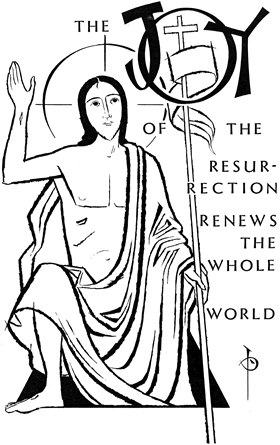
You may not recognize the name, but if you are Catholic, you know the artist that he was--there is no American Catholic, whose art dominated the post-Vatican II church more (in the U.S.) than Brother Placid's...
From St. John's Abbey:
Brother Placid began full time work at the Liturgical Press around 1965 as its primary illustrator. He designed layout and jackets for dozens of books, and produced hundreds of illustrations. His work appeared in the Bible and Liturgy Bulletin for 41 years. He spent 1970 on assignment in Puerto Rico while continuing to work for Liturgical Press by mail. Brother Placid employed a wide variety of media that included pen and wash, collage, watercolor, welded metal, wooden sculpture and photography.
After the Second Vatican Council, he accepted invitations from many parishes in the Upper Midwest to serve as a liturgical consultant. Parishes were renovating church sanctuaries and their furnishings. For eleven years he also provided art once a month for the diocesan newspaper, The St. Cloud Visitor.
Besides his time at Layton School of Art, Brother Placid also studied at the University of Notre Dame, the Blackhawk Mountain School of Art in Colorado, and the Sagrada Art Studio in Albuquerque. In 1974, at the Instituto San Miquel de Allende in Guanajusto, Mexico, he created depictions of St. Francis of Rome and St. Augustine of Hippo for chapels on the lower level of the Abbey Church.
Some of Brother Placid's more visible works include "The Four Evangelists," a metal sculpture on the façade of Liturgical Press, and the road signs on old Highway 52 that formerly greeted visitors to the university, prep school, and abbey.
Tortured Priest's Tenacity Exposes Betrayal in Church
From the Star Tribune:
Eighteen months ago, the Rev. Tadeusz Isakowicz-Zaleski, heard a startling report on the radio.
Communist-era files thought to have been destroyed years ago had in fact been preserved, the report said. They chronicled obsessive efforts by the SB, the regime's despised security police, to intimidate or compromise Roman Catholic clergy who were lending moral support to the Solidarity trade union movement.
One of the thickest files, according to the radio report, was Zaleski's.
Four days later, the priest went to the Institute of National Remembrance and asked to see his file. It was 500 pages long, and included a videotape of a 1985 torture session during which a gang of SB goons used cigarettes to tattoo a Solidarity "V" on Zaleski's chest. The SB apparently used the tape as a training tool.
Despite warnings from the church to let the matter rest, Zaleski continued to dig into the files. The result is a book to be published this week that will identify 39 clergymen in the Krakow archdiocese, including five bishops, who served as SB informants or collaborators.
Eighteen months ago, the Rev. Tadeusz Isakowicz-Zaleski, heard a startling report on the radio.
Communist-era files thought to have been destroyed years ago had in fact been preserved, the report said. They chronicled obsessive efforts by the SB, the regime's despised security police, to intimidate or compromise Roman Catholic clergy who were lending moral support to the Solidarity trade union movement.
One of the thickest files, according to the radio report, was Zaleski's.
Four days later, the priest went to the Institute of National Remembrance and asked to see his file. It was 500 pages long, and included a videotape of a 1985 torture session during which a gang of SB goons used cigarettes to tattoo a Solidarity "V" on Zaleski's chest. The SB apparently used the tape as a training tool.
Despite warnings from the church to let the matter rest, Zaleski continued to dig into the files. The result is a book to be published this week that will identify 39 clergymen in the Krakow archdiocese, including five bishops, who served as SB informants or collaborators.
Wednesday, February 28, 2007
Cardinal Biffi's Lenten Talk on the Antichrist
To the Pope, from Zenit, quoting Soloviev:
According to Vatican Radio's summary of his preaching, the cardinal explained that "the teaching that the great Russian philosopher left us is that Christianity cannot be reduced to a set of values. At the center of being a Christian is, in fact, the personal encounter with Jesus Christ."
Quoting the work "Three Dialogues on War, Progress and the End of History," Cardinal Biffi told his listeners that "the Antichrist presents himself as pacifist, ecologist and ecumenist."
"He will convoke an ecumenical council and will seek the consensus of all the Christian confessions, granting something to each one. The masses will follow him, with the exception of small groups of Catholics, Orthodox and Protestants," he said.
The cardinal added that Solovyov says in that work: "Days will come in Christianity in which they will try to reduce the salvific event to a mere series of values."
No cross
In his "Tale of the Antichrist" Solovyov foresees that a small group of Catholics, Orthodox and Protestants will resist and will say to the Antichrist: "You give us everything, except what interests us, Jesus Christ."
For Cardinal Biffi, this narrative is a warning: "Today, in fact, we run the risk of having a Christianity which puts aside Jesus with his cross and resurrection."
The 78-year-old cardinal said that if Christians "limited themselves to speaking of shared values they would be more accepted on television programs and in social groups. But in this way, they will have renounced Jesus, the overwhelming reality of the resurrection."
The cardinal said he believes that this is "the danger that Christians face in our days … the Son of God cannot be reduced to a series of good projects sanctioned by the prevailing worldly mentality."
However, "this does not mean a condemnation of values, but their careful discernment. There are absolute values, such as goodness, truth, beauty," Cardinal Biffi said. "Those who perceive and love them, also love Christ, even if they don't know it, because he is Truth, Beauty and Justice."
The preacher of the Spiritual Exercises added that "there are relative values, such as solidarity, love of peace and respect for nature. If these become absolute, uprooting or even opposing the proclamation of the event of salvation, then these values become an instigation to idolatry and obstacles on the way of salvation."
Cardinal Biffi affirmed that "if Christianity -- on opening itself to the world and dialoguing with all -- dilutes the salvific event, it closes itself to a personal relationship with Jesus and places itself on the side of the Antichrist."
According to Vatican Radio's summary of his preaching, the cardinal explained that "the teaching that the great Russian philosopher left us is that Christianity cannot be reduced to a set of values. At the center of being a Christian is, in fact, the personal encounter with Jesus Christ."
Quoting the work "Three Dialogues on War, Progress and the End of History," Cardinal Biffi told his listeners that "the Antichrist presents himself as pacifist, ecologist and ecumenist."
"He will convoke an ecumenical council and will seek the consensus of all the Christian confessions, granting something to each one. The masses will follow him, with the exception of small groups of Catholics, Orthodox and Protestants," he said.
The cardinal added that Solovyov says in that work: "Days will come in Christianity in which they will try to reduce the salvific event to a mere series of values."
No cross
In his "Tale of the Antichrist" Solovyov foresees that a small group of Catholics, Orthodox and Protestants will resist and will say to the Antichrist: "You give us everything, except what interests us, Jesus Christ."
For Cardinal Biffi, this narrative is a warning: "Today, in fact, we run the risk of having a Christianity which puts aside Jesus with his cross and resurrection."
The 78-year-old cardinal said that if Christians "limited themselves to speaking of shared values they would be more accepted on television programs and in social groups. But in this way, they will have renounced Jesus, the overwhelming reality of the resurrection."
The cardinal said he believes that this is "the danger that Christians face in our days … the Son of God cannot be reduced to a series of good projects sanctioned by the prevailing worldly mentality."
However, "this does not mean a condemnation of values, but their careful discernment. There are absolute values, such as goodness, truth, beauty," Cardinal Biffi said. "Those who perceive and love them, also love Christ, even if they don't know it, because he is Truth, Beauty and Justice."
The preacher of the Spiritual Exercises added that "there are relative values, such as solidarity, love of peace and respect for nature. If these become absolute, uprooting or even opposing the proclamation of the event of salvation, then these values become an instigation to idolatry and obstacles on the way of salvation."
Cardinal Biffi affirmed that "if Christianity -- on opening itself to the world and dialoguing with all -- dilutes the salvific event, it closes itself to a personal relationship with Jesus and places itself on the side of the Antichrist."
"Who are you, Moses?
The quote is from Schindler's List. Now to my application of the Scriptures to the news of the day:
From Jude 1:9:
But when the archangel Michael, contending with the devil, disputed about the body of Moses, he did not presume to pronounce a reviling judgment upon him, but said, "The Lord rebuke you."
Playmate Burial Dispute Back in Court
Just bury the poor girl, stop fighting over the body!
From Jude 1:9:
But when the archangel Michael, contending with the devil, disputed about the body of Moses, he did not presume to pronounce a reviling judgment upon him, but said, "The Lord rebuke you."
Playmate Burial Dispute Back in Court
Just bury the poor girl, stop fighting over the body!
This Lent, Empty Your Closets!
Then what?
Donations Central is an index of charities that accept clothing donations. Each charity profile contains a brief description and contact information. We aim to make it as easy as possible to find a group in need to donate your clothing.
Subscribe to:
Posts (Atom)
