Thursday, January 29, 2026

Free Book on the Catholic Mass

      Eucharist means..."thanksgiving"


Michael Dubruiel wrote a book to help people deepen their experience of the Mass.  He titled it, How to Get the Most Out of the Eucharist.  You can read about it here. It is available free today (1/29/2025)

The following is an excerpt from the introduction:


Problems…            I had the opportunity to speak about the Eucharist to various groups of people in almost every part of the United States since the release of The How To Book of the Mass, a book I wrote several years ago. No matter where I happened to be, I received the same response. A dissatisfaction of sorts often rooted in how things were being done at their home parish.


            Some of these same people longed for the “old” days of the Tridentine liturgy (and an alarming number of young Catholics). Yet I know from conversations that I've had with older priests that the old liturgy was subject to many of the same problems as today's Mass.


What was different forty years ago is the attitude that Catholics brought to the Eucharist back then was more sacrificial. A term that one often heard older Catholics use was "to offer it up" when things didn't go the way you expected or wished. This sacrificial attitude made a previous generation of Catholics focus not on themselves but on what God wanted of them.


By the time I attended a Catholic College in the early 1980’s people were being made fun of if they still had this attitude. I remember a very pious student one day suggesting to another student who was complaining about the difficulty of an upcoming test that he “offer-up” the suffering he was undergoing for the poor souls in Purgatory. His fellow student replied, “Are you nuts?” Everyone at the table laughed. It was symbolic of a change in the Catholic psyche.


The Eucharist was viewed almost entirely as a banquet; a picnic table replaced the stone altar in the chapel, it was moved from the front of the chapel to the center.  The emphasis was more horizontal. The pendulum was swinging in the other direction, after many years where it would have been difficult to think of the Mass as a meal, now it was nearly impossible to encounter the Eucharist as a sacrifice.


Some twenty years later the pendulum is returning to the middle. My college chapel has been renovated yet again. The table is gone replaced by a very ornate altar that is located in the middle of the congregation. Images once removed have returned and there is more of a flow of the feeling that both God and humans occupy this worship space.
Pope John Paul in his Encyclical on the Eucharist Ecclesia de Eucharistia has mentioned as one of the modern “shadows” or problems with the way Catholics understand the Eucharist is that "Stripped of its sacrificial meaning, it is celebrated as if it were simply a fraternal banquet[i]."


            It is my belief that this downplaying the sacrificial nature of the Eucharist is the main reason that many of us are not getting the most out of the Eucharist. Over time we lose sight of why we even go or worst the Eucharist gets relegated to one more social obligation that one can easily decide not to attend.

[i] Ecclesia De Eucharistia (10)


Michael Dubruiel


How to Get the Most Out of the Eucharist gives you nine concrete steps to help you join your own sacrifice to the sacrifice of Christ as you:
  • Serve: Obey the command that Jesus gave to his disciples at the first Eucharist.
  • Adore: Put aside anything that seems to rival God in importance.
  • Confess: Believe in God’s power to make up for your weaknesses.
  • Respond" Answer in gesture, word, and song in unity with the Body of Christ.
  • Incline: Listen with your whole being to the Word of God.
  • Fast: Bring your appetites and desires to the Eucharist.
  • Invite: Open yourself to an encounter with Jesus.
  • Commune: Accept the gift of Christ in the Eucharist.
  • Evangelize :Take him and share the Lord with others.

Wednesday, January 28, 2026

Thomas Aquinas - January 28

      From 2003, by Michael Dubruiel


Aquinas Thought of Everything


Below is a quote from Summa Contra Gentiles. I've been familar with the notion that St. Thomas said we'd all be 33 in Heaven regardless of when we died (before or after that age), but no one every seemed to know where he'd said it. Well here it is, along with an interesting discussion on the other qualities of the glorified body:


From Jacques Maritain Center: GC 4.88:


"STILL we must not suppose, what some have thought, that female sex has no place in the bodies of the risen Saints. For since resurrection means the reparation of the defects of nature, nothing of what makes for the perfection of nature will be withdrawn from the bodies of the risen. Now among other organs that belong to the integrity of the human body are those which minister to generation as well in male as in female. These organs therefore will rise again in both. Nor is this conclusion impaired by the fact that there will be no longer any use of these organs (Chap. LXXXIII). If that were any ground for their absence from the risen body, all the organs bearing on digestion and nutrition should be absent, for there will not be any use for them either: thus great part of the organs proper to man would be wanting in the risen body. We conclude that all such organs will be there, even organs of which the function has ceased: these will not be there without a purpose, since they will serve to make up the restored integrity of the natural body.*


Neither is the weakness of the female sex inconsistent with the perfection of the resurrection. Such weakness is no departure from nature, but is intended by nature.* This natural differentiation will argue the thoroughgoing perfection of nature, and commend the divine wisdom that arranges creation in diversity of ranks and orders. Nor is there anything to the contrary in the expression of the Apostle: Till we all meet and attain to the unity of faith and recognition of the Son of God, even to a perfect man, to the measure of the full stature of Christ (Eph. iv, 13). This does not mean that in that meeting in which the risen shall go forth to meet Christ in the air* every one shall be of the male sex, but it indicates the perfection and strength of the Church, for the whole Church shalt be like a perfect, full-grown man, going out to meet Christ.*


Again, all must rise at the age of Christ,* which is the age of perfect manhood, for the sake of the perfection of nature, which is at its best in this age above others.


"michael Dubruiel"


Tuesday, January 27, 2026

Michael Dubruiel Books

 Go here to explore Michael Dubruiel's books:

"michael Dubruiel"


Maybe you are a recent convert, or perhaps you've attended Mass your whole life, but there are still things that puzzle you, like: when you should genuflect and when you should bow; what the different books used at Mass are and what they contain; the meaning of words like "Amen," "Alleluia," or "Hosanna"; what to do during the sign of peace.

You aren't alone.

The How-to Book of the Mass not only provides the who, what, where, when, and why of the most time-honored traditions of the Catholic Church, but also the how. All in an easy-to-read, easy-to-understand format.

In this complete guide to the celebration of the Eucharist you get:

  • Step-by-step guidelines to walk you through the Mass
  • Biblical background of the prayers of the Mass
  • Insights from the Tradition and teaching of the Church
  • Practical aid to overcoming distractions
  • Concrete ways to grow in your relationship with Jesus Christ at every Mass
  • A handy study guide for individual or group use

    Includes 2011 Roman Missal Translation changes.


Monday, January 26, 2026

Sts. Timothy and Titus - January 26

 From Pope Benedict XVI:


To conclude, if we consider together the two figures of Timothy and Titus, we are aware of certain very significant facts. The most important one is that in carrying out his missions, Paul availed himself of collaborators. He certainly remains the Apostle par excellence, founder and pastor of many Churches.

Yet it clearly appears that he did not do everything on his own but relied on trustworthy people who shared in his endeavours and responsibilities.

Another observation concerns the willingness of these collaborators. The sources concerning Timothy and Titus highlight their readiness to take on various offices that also often consisted in representing Paul in circumstances far from easy. In a word, they teach us to serve the Gospel with generosity, realizing that this also entails a service to the Church herself.

Lastly, let us follow the recommendation that the Apostle Paul makes to Titus in the Letter addressed to him: "I desire you to insist on these things, so that those who have believed in God may be careful to apply themselves to good deeds; these are excellent and profitable to men" (Ti 3: 8).

Through our commitment in practice we can and must discover the truth of these words, and precisely in this Season of Advent, we too can be rich in good deeds and thus open the doors of the world to Christ, our Saviour.


Michael Dubruiel's books


"michael dubruiel"


Sunday, January 25, 2026

The Conversion of Paul - January 25

      The Cross of Christ Illumines. . . Blindness “ by Michael Dubruiel


As I made my journey and drew near to Damascus, about noon a great light from heaven suddenly shone about me. And I fell to the ground and heard a voice saying to me, ‘Saul, Saul, why do you persecute me?’ And I answered ‘Who are you, Lord?’ And he said to me, ‘I am Jesus of Nazareth whom you are persecuting.” Now those who were with me saw the light but did not hear the voice of the one who was speaking to me. And I said, ‘What shall I do, Lord?’ And the Lord said to me, ‘Rise, and go to Damascus, and you will be told all that is appointed for you to do.’ And when I could not see because of the brightness of that light, I was led by the hand by those who were with me, and came into Damascus.” ACTS 22:6–11 


Jesus said, “For Judgment I came into this world, that those who do not see may see, and that those who see may become blind.” Some of the Pharisees near him heard this, and they said to him, “Are we also blind?” Jesus said to them, “If you were blind, you would have no guilt; but now that you say, ‘We see,’ your guilt remains.” JOHN 9:39–41 


The most unique Holy Saturday I ever experienced occurred when my wife and I decided to go to a monastery for Holy Week . Saturday was a rainy day and we decided to go to a nearby spot that was advertised up and down the interstate as the place to visit when you were passing through this part of the country— it was a cave. What better spot to spend Holy Saturday, I reasoned, than under the earth? After all, Jesus’ body had lain in a tomb on that first Holy Saturday.

 So we drove a few miles away from the monastery and joined a group of other travelers in an out-of-the-way location to descend into the earth and explore one of nature’s wonders. What I remember most about the tour of the cave had little to do with the stalactites or the stalagmites but something else that we experienced once we had gone deep into the cave. The tour guide asked us, “How many of you think you have experienced total darkness?” A few people raised their hands. He then told us that he was going to turn off the artificial lighting that illuminated the cave so that we could experience what the first people who had discovered this cave experienced when their light went out. There was nothing but total, pitch darkness. I held my hand in front of my face but could see absolutely nothing. I knew that it was there because I could sense it but I could see absolutely nothing, no shadow, no outline—just a horrible darkness. It was the closest that I have ever come to having some understanding of what it must be like to be totally blind.

 In Pilgrim at Tinker Creek, in a chapter entitled “Seeing,” Annie Dillard wrote about people born blind whose sight was restored by a medical procedure. The reaction of those thus healed wasn’t what one might expect. Some wanted to go back to the darkness—they found the light too much. Others enjoyed the gift of vision, but to those who had been in darkness since birth it seemed to them that everything was made of light. Blinded by the Light In John’s Gospel, Jesus divides the world into two camps: those who encounter his light and have their sight restored, and those who encounter that light and are blinded. Jesus told Nicodemus, “And this is the judgment, that the light has come into the world, and men loved darkness rather than light, because their deeds were evil” (John 3:19).

In John’s Gospel, Jesus heals a blind man, who has not only his physical sight restored but also comes to see that Jesus is worthy of worship. The Pharisees who question the blind man refuse to believe, no matter how much evidence is brought forward to prove that Jesus had healed him. Another Pharisee, Saul of Tarsus, later persecuted the followers of Jesus. While setting out on one such mission, Saul was struck by a light from heaven, and heard the voice of Jesus, the suffering Christ. Saul was blinded on his way to Damascus, where a follower of Jesus healed him. Saul became St. Paul, one of the greatest followers of Christ. The preaching of Paul would focus on the crucified Christ, leading many artists to portray the scene of Paul’s conversion as an encounter with a cross of light.

None of the Pharisees, including Saul, thought that persecuting the followers of Christ was evil; in fact, they thought they were doing the will of God. We all risk falling into the same trap. How well do you and I truly see? Do we see everything made of light? Or do we only partially see reality as it is?

A World Made of Light 

There have been times in my life when I have called upon God to save or help me, and God has answered in dramatic ways. At
 first I gave thanks for God’s intervention in my life. But with time my inner Pharisee began to question the events: Was God really responsible? There are those who believe that we live in an age when miracles have ceased, but I know better. Miracles abound—we just don’t always recognize them. Those cured of physical blindness perceive the world to be made of light; the same is true of those cured of spiritual blindness. What seemed dark and hopeless suddenly becomes a path to glory. The psalmist reflects this spiritual vision when he prays in perhaps the best-known psalm, “Even though I walk through the valley of the shadow of death, I fear no evil; for thou art with me” (Psalm 23:4). Today there are eye surgeries that allow people to see clearly without corrective lenses. We need the “surgery of the cross” to restore our vision, allowing us to see the world as God sees it. The person filled with the Light perceives light, even in apparent total darkness. As we read in the Gospel of Matthew: “The eye is the lamp of the body. So, if your eye is sound, your whole body will be full of light; but if your eye is not sound, your whole body will be full of darkness. If then the light in you is darkness, how great is the darkness!” (Matthew 6:22–23). Lord Jesus, touch our eyes that we might see!


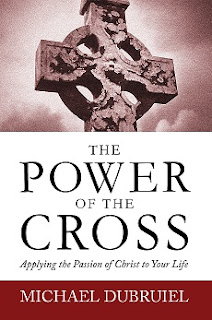
The Power of the Cross is a book well-suited to daily reading during Lent.  Daily excerpts will be reprinted in this space during Lent.


"michael Dubruiel"