A great book for the Eucharistic Revival and Pilgrimage!
Wednesday, May 22, 2024
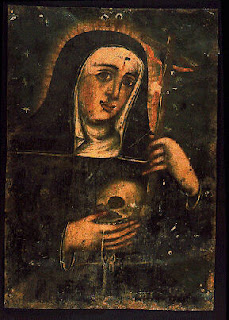
St. Rita of Cascia - May 22
From The Church's Most Powerful NovenasRita Lotti was born near Cascia in Italy in the fourteenth century, the only child of her parents, Antonio and Amata. Her parents were official peacemakers in a turbulent environment of feuding families.
At an early age Rita felt called to religious life; however, her parents arranged for her to be married to Paolo Mancini. Rita accepted this as God’s will for her, and the newlyweds were soon blessed with two sons.
One day while on his way home, Paolo was killed. Rita’s grief was compounded with the fear that her two sons would seek to avenge their father’s death, as was the custom of the time. She began praying and fasting that God would not allow this to happen. Both sons soon fell ill and died, which Rita saw as an answer to her prayers.
Now alone in the world, Rita sought to enter religious life, feeling that God had cleared the path for her to fulfill the vocation that she had felt was hers from childhood. Yet she found that the convent she so desired to enter was reluctant to accept her due to fears that the political rivals that had killed her husband would bring violence on them.
She finally brought peace between the rivals and was able to enter the Convent of St. Mary Magdalene of the Augustinian Nuns. In religious life, Rita was noted for her holiness. She spent her days not only in prayer and contemplation but also in service to the sick and the poor.
One day while kneeling in prayer and contemplating the passion of Jesus, she received the wound of one thorn from the crown of thorns that she bore until her death some fifteen years later.
Devotion to St. Rita was almost nonexistent for five hundred years, but with her canonization in 1900, all of that has changed. She is truly a saint for every state in life, having spent her life as a married woman, a mother, a widow, and a religious.
Monday, May 20, 2024
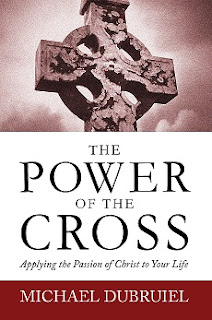
Michael Dubruiel: Pentecost Octave
The letter to the Hebrews draws a strong connection
between the cross and prayer. Because every moment of our
earthly existence is threatened by death, and we know neither the
day nor the hour when that existence will come to an end, we,
too, need to cry out to the God who can save us. Like Moses, we
need the help of our fellow Christians to hold up our arms when
they grow tired. We, too, need the help of the Holy Spirit to
make up for what is lacking in our prayer.
-The Power of the Cross by Michael Dubruiel
Sunday, May 19, 2024
Pentecost - a Glorious Mystery
Michael Dubruiel conceived and put together the small hardbound book, Praying the Rosary. Click on the cover for more information.
The Gospels show that the gaze of Mary varied depending upon the circumstances of life. So it will be with us. Each time we pick up the holy beads to recite the Rosary, our gaze at the mystery of Christ will differ depending on where we find ourselves at that moment.
Thereafter Mary’s gaze, ever filled with adoration and wonder, would never leave him. At times it would be a questioning look, as in the episode of the finding in the Temple: “Son, why have you treated us so?” (Lk 2:48); it would always be a penetrating gaze, one capable of deeply understanding Jesus, even to the point of perceiving his hidden feelings and anticipating his decisions, as at Cana (cf. Jn 2:5). At other times it would be a look of sorrow, especially beneath the Cross, where her vision would still be that of mother giving birth, for Mary not only shared the passion and death of her Son, she also received the new son given to her in the beloved disciple (cf. Jn 19:26-27). On the morning of Easter hers would be a gaze radiant with the joy of the Resurrection, and finally, on the day of Pentecost, a gaze afire with the outpouring of the Spirit (cf. Acts 1:14) [Rosarium Virginis Mariae, no. 10].
As we pray the Rosary, then, we join with Mary in contemplating Christ. With her, we remember Christ, we proclaim Him, we learn from Him, and, most importantly, as we raise our voices in prayer and our hearts in contemplation of the holy mysteries, this “compendium of the Gospel” itself, we are conformed to Him.
Saturday, May 18, 2024
Pentecost Vigil
The Mass Readings for the Pentecost Vigil:
On the last and greatest day of the feast,
Jesus stood up and exclaimed,
“Let anyone who thirsts come to me and drink.
As Scripture says:
Rivers of living water will flow from within him who believes in me.”
He said this in reference to the Spirit
that those who came to believe in him were to receive.
There was, of course, no Spirit yet,
because Jesus had not yet been glorified.
Friday, May 17, 2024
Eucharistic Pilgrimage Begins May 17
Today is the first day of the national Eucharistic Pilgrimage:
The National Eucharistic Pilgrimage is a truly unique initiative. This is something NEW—a beautiful fusion of the journey TO Jesus and the journey WITH Jesus. What’s more, it is an adventure that all Catholics can do together, either by interior disposition or physical accompaniment.
This is the birth of something remarkable. Join us as we accompany Jesus in the Eucharist from the north, south, east, and west edges of our country, stopping at many holy sites and churches along the way. Together we will journey with Christ on his way to the 10th National Eucharistic Congress, where he comes to encounter his people anew.
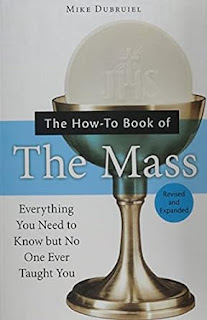
A good resource for deepening one's appreciation of the Eucharist would be The How-To Book of the Mass by Michael Dubruiel:
Maybe you are a recent convert, or perhaps you've attended Mass your whole life, but there are still things that puzzle you, like: when you should genuflect and when you should bow; what the different books used at Mass are and what they contain; the meaning of words like "Amen," "Alleluia," or "Hosanna"; what to do during the sign of peace.
You aren't alone.
The How-to Book of the Mass not only provides the who, what, where, when, and why of the most time-honored traditions of the Catholic Church, but also the how. All in an easy-to-read, easy-to-understand format.
In this complete guide to the celebration of the Eucharist you get:
- Step-by-step guidelines to walk you through the Mass
- Biblical background of the prayers of the Mass
- Insights from the Tradition and teaching of the Church
- Practical aid to overcoming distractions
- Concrete ways to grow in your relationship with Jesus Christ at every Mass
- A handy study guide for individual or group use
Includes 2011 Roman Missal Translation changes.
Thursday, May 16, 2024
Pentecost Novena - Part 3
Now is the time to pray to Pentecost Novena. What is a novena? Why should we pray it?
Here's an explanation from The Church's Most Powerful Novenas by Michael Dubruiel (part 2)
3. Praying a novena teaches us the benefit of praying with others to God. While the Second Vatican Council sought to renew a sense of the communal nature of prayer, some of the more zealous sought to achieve this by erasing one aspect of Catholicism where the sense of communal prayer was already a lived reality: the involvement of the Church Victorious — the saints.
Recently while I was visiting an Eastern Orthodox Church, the beauty and the symbolism of the iconostasis struck me. An iconostasis is a wall of icons (consisting of painted images of God, the Blessed Virgin, and the saints) that separates the sanctuary from the nave of the church. In Orthodox churches the walls are covered with icons as a testament that when we on earth gather in prayer, we do not pray alone, but are joined by all of those who have gone before us and are now in heaven. The next day, while I was at Mass in an inner-city church in Detroit, Michigan, I was struck by the statues of the saints (which, in the post-Vatican II Church, are a rarity) and how much they resembled the iconostasis of the Orthodox Church, except ours were three-dimensional.
Wednesday, May 15, 2024
Pentecost Novena - Part 2
Now is the time to pray to Pentecost Novena. What is a novena? Why should we pray it?
Here's an explanation from The Church's Most Powerful Novenas by Michael Dubruiel (part 2)
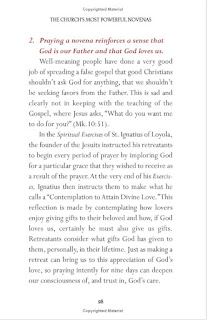
2. Praying a novena reinforces a sense that God is our Father and that God loves us. Well-meaning people have done a very good job of spreading a false gospel that good Christians shouldn't ask God for anything, that we shouldn't be seeking favors from the Father. This is sad and clearly not in keeping with the teaching of the Gospel, where Jesus asks, "What do you want me to do for you?" (Mk. 10:51).
In the Spiritual Exercises of St. Ignatius of Loyola, the founder of the Jesuits instructed his retreatants to begin every period of prayer by imploring God for a particular grace that they wished to receive as a result of the prayer. At the very end of his Exercises, Ignatius then instructs them to make what he calls a "Contemplation to Attain Divine Love."
This reflection is made by contemplating how lovers enjoy giving gifts to their beloved and how, if God loves us, certainly he must also give us gifts. Retreatants consider what gifts God has given to them, personally, in their lifetime. Just as making a retreat can bring us to this appreciation of God's love, so praying intently for nine days can deepen our consciousness of, and trust in, God's care.
Tuesday, May 14, 2024
Mary and the Muslims - Fatima
MARY
The Qu'ran, which is the Bible for the Muslims, has many passages concerning the Blessed Virgin. First of all, the Qu'ran believes in her Immaculate Conception, and also in her Virgin Birth. The third chapter of the Qu'ran places the history of Mary's family in a genealogy which goes back through Abraham, Noah, and Adam. When one compares the Qu'ran's description of the birth of Mary with the apocryphal Gospel of the birth of Mary, one is tempted to believe that Mohammed very much depended upon the latter. Both books describe the old age and the definite sterility of the mother of Mary. When, however, she conceives, the mother of Mary is made to say in the Qu'ran: "O Lord, I vow and I consecrate to you what is already within me. Accept it from me."
When Mary is born, the mother says: And I consecrate her with all of her posterity under thy protection, O Lord, against Satan!"
The Qu'ran passes over Joseph in the life of Mary, but the Muslim tradition knows his name and has some familiarity with him. In this tradition, Joseph is made to speak to Mary, who is a virgin. As he inquired how she conceived Jesus without a father, Mary answered:
Do you not know that God, when he created the wheat had no need of seed, and that God by his power made the trees grow without the help of rain? All that God had to do was to say, 'So be it, and it was done.'
The Qu'ran was also verses on the Annunciation, Visitation, and Nativity. Angels are pictured as accompanying the Blessed Mother and saying: "Oh, Mary, God has chosen you and purified you, and elected you above all the women of the earth." In the nineteenth chapter of the Qu'ran there are 41 verses on Jesus and Mary. There is such a strong defense of the virginity of Mary here that the Qu'ran, in the fourth book, attributed the condemnation of the Jews to their monstrous calumny against the Virgin Mary.
FATIMA
Mary, then, is for the Muslims the true Sayyida, or Lady. The only possible serious rival to her in their creed would be Fatima, the daughter of Mohammed himself. But after the death of Fatima, Mohammed wrote: "Thou shalt be the most blessed of all women in Paradise, after Mary." In a variation of the text, Fatima is made to say, "I surpass all the women, except Mary."
This brings us to our second point: namely, why the Blessed Mother, in the 20th century, should have revealed herself in the insignificant little village of Fatima, so that to all future generations she would be known as "Our Lady of Fatima." Since nothing ever happens out of Heaven except with a finesse of all details, I believe that the blessed Virgin chose to be known as "Our Lady of Fatima" as a pledge and a sign of hope to the Muslim people, and as an assurance that they, who show her so much respect, will one day accept her divine Son too.
Evidence to support these views is found in the historical fact that the Muslims occupied Portugal for centuries. At the time when they were finally driven out, the last Muslim chief had a beautiful daughter by the name of Fatima. A Catholic boy fell in love with her, and for him she not only stayed behind when the Muslims left, but even embraced the faith. The young husband was so much in love with her that he changed the name of the town where he lived to Fatima. Thus, the very place where our lady appeared in 1917 bears a historical connection to Fatima, the daughter of Mohammed.
The final evidence of the relationship of Fatima to the Muslims is the enthusiastic reception which the Muslims in Africa, India, and elsewhere gave to the pilgrim statue of Our Lady of Fatima. Muslims attended the church services in honor of our Lady, they allowed religious processions and even prayers before their mosques; and in Mozambique, the Muslims who were unconverted, began to be Christian as soon as the statue of Our Lady of Fatima was erected.
Monday, May 13, 2024
Pentecost Novena - 1
Now is the time to pray to Pentecost Novena. What is a novena? Why should we pray it?
Here's an explanation from The Church's Most Powerful Novenas by Michael Dubruiel
Sunday, May 12, 2024
A Pocket Guide to Confession
For a brief, pointed and helpful guide,
Saturday, May 11, 2024
Mother's Day Gift
Michael Dubruiel conceived and put together the small hardbound book, Praying the Rosary. Click on the cover for more information.

The Gospels show that the gaze of Mary varied depending upon the circumstances of life. So it will be with us. Each time we pick up the holy beads to recite the Rosary, our gaze at the mystery of Christ will differ depending on where we find ourselves at that moment.
Thereafter Mary’s gaze, ever filled with adoration and wonder, would never leave him. At times it would be a questioning look, as in the episode of the finding in the Temple: “Son, why have you treated us so?” (Lk 2:48); it would always be a penetrating gaze, one capable of deeply understanding Jesus, even to the point of perceiving his hidden feelings and anticipating his decisions, as at Cana (cf. Jn 2:5). At other times it would be a look of sorrow, especially beneath the Cross, where her vision would still be that of mother giving birth, for Mary not only shared the passion and death of her Son, she also received the new son given to her in the beloved disciple (cf. Jn 19:26-27). On the morning of Easter hers would be a gaze radiant with the joy of the Resurrection, and finally, on the day of Pentecost, a gaze afire with the outpouring of the Spirit (cf. Acts 1:14) [Rosarium Virginis Mariae, no. 10].
As we pray the Rosary, then, we join with Mary in contemplating Christ. With her, we remember Christ, we proclaim Him, we learn from Him, and, most importantly, as we raise our voices in prayer and our hearts in contemplation of the holy mysteries, this “compendium of the Gospel” itself, we are conformed to Him.
Friday, May 10, 2024
Pentecost Novena
Pentecost 2024 is May 19
Thursday, May 09, 2024
Michael Dubruiel: Feast of the Ascension
The first reading at Mass, from the Acts of the Apostles:
I dealt with all that Jesus did and taught
until the day he was taken up,
after giving instructions through the Holy Spirit
to the apostles whom he had chosen.
He presented himself alive to them
by many proofs after he had suffered,
appearing to them during forty days
and speaking about the kingdom of God.
While meeting with the them,
he enjoined them not to depart from Jerusalem,
but to wait for “the promise of the Father
about which you have heard me speak;
for John baptized with water,
but in a few days you will be baptized with the Holy Spirit.”
“Lord, are you at this time going to restore the kingdom to Israel?”
He answered them, “It is not for you to know the times or seasons
that the Father has established by his own authority.
But you will receive power when the Holy Spirit comes upon you,
and you will be my witnesses in Jerusalem,
throughout Judea and Samaria,
and to the ends of the earth.”
When he had said this, as they were looking on,
he was lifted up, and a cloud took him from their sight.
While they were looking intently at the sky as he was going,
suddenly two men dressed in white garments stood beside them.
They said, “Men of Galilee,
why are you standing there looking at the sky?
This Jesus who has been taken up from you into heaven
will return in the same way as you have seen him going into heaven.”
Wednesday, May 08, 2024
Fulton Sheen Birthday - May 8
Today, May 8, is Fulton Sheen's birthday.
Bishop Sheen’s “Now-moment” corresponds to the thinking of the great spiritual writer Jean Pierre de Caussade. In Abandonment to Divine Providence, Fr. Caussade gives the reader a sure way of knowing the will of God at any moment—by simply confronting the present moment with all its reality. It seems simple, but if we reflect for a second most of us will find that we spend most of our lives avoiding the present moment.
A few years ago an English translation of the Father Caussade’s work appeared in the United States changing the original title to read “The Sacrament of the Present Moment.” This captures the essence of Father Caussade’s work and Bishop Sheen’s meditation that in the present time we are presented with an opportunity that is truly unique. Each moment is sacramental.
Most of us are capable of presenting ourselves with some amount of reflection as we celebrate the sacraments. If we celebrated the sacrament of Baptism as an adult certainly we came expecting to be changed by God. Each time we enter a confessional surely we have examined our conscience beforehand and are penitent expecting to be forgiven by God. Undoubtedly every time we approach the altar to receive the Eucharist we expect to encounter God. But what about the other moments of our lives?
As we awake in the morning, is our first thought of God? As we greet our brothers and sisters throughout the day do we expect that God might be present? Every moment of our lives is an opportunity to encounter God who is always present.
Spend some time reflecting on the following:
1. Go over the events of the present day and ask yourself where God might have been in each of them. Is there a consistent pattern to your day?
2. Reflect on the life of your favorite saint, and meditate on how he or she dealt with the people they met in their daily journeys. How could you imitate this saint? What enabled the saint to act in the way he or she did toward others?
3. Imagine as you leave from this time of prayer that God wishes to continue to be present to you as you go forth. How will you react to his presence in others?
PrayerLord, help me to search for you in the garden of life in the same way that St. Mary Magdalene did when she found your tomb empty. May my search be rewarded as hers was by knowledge of your abiding presence. Amen.
Tuesday, May 07, 2024
Eucharistic Revival Guide to the Mass
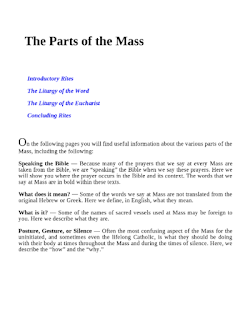
Michael Dubruiel's Pocket Guide to the Mass - a sample page.
Walks you through the Mass, explaining the biblical basis of prayers, the meaning behind gestures, and a brief overview of the spirituality that brings Catholics together for Eucharist each week.
Published in 2007, still in print.
An excellent resource for your parish for the Eucharistic Revival year.
More books by Michael Dubruiel