Steps to Take as You Follow ChristAsk— What do I do with God’s spirit?Seek—From a prayer posture, concentrate on your breathing. Asyou inhale, ask God to fill you with the Holy Spirit, to animateyour every action to do his will. As you exhale, breathe the namefrom the core of your being: Jesus. Continue to meditate on him.Knock—Meditate on Galatians 6:7–9. Reflect on the differencebetween a living person and a corpse. Are most of your actions,actions of sowing in the flesh or sowing to the spirit? Ask Godfor patience that you might endure in all things by sowing to thespirit.Transform Your Life—Make it a habit to pray the prayer ofJesus from the cross whenever you find yourself tempted to dosomething that you know is not of God: “Father, into your handsI commend my Spirit.” This prayer that Jesus has given us is thekey to moving from sowing in the flesh to sowing to the spirit.
Monday, June 05, 2017
The Holy Spirit and Pentecost
Sunday, June 04, 2017
Pentecost - A Glorious Mystery of the Rosary
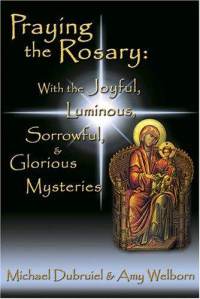
Michael Dubruiel conceived and put together the small hardbound book, Praying the Rosary. Click on the cover for more information.
The Gospels show that the gaze of Mary varied depending upon the circumstances of life. So it will be with us. Each time we pick up the holy beads to recite the Rosary, our gaze at the mystery of Christ will differ depending on where we find ourselves at that moment.
Thereafter Mary’s gaze, ever filled with adoration and wonder, would never leave him. At times it would be a questioning look, as in the episode of the finding in the Temple: “Son, why have you treated us so?” (Lk 2:48); it would always be a penetrating gaze, one capable of deeply understanding Jesus, even to the point of perceiving his hidden feelings and anticipating his decisions, as at Cana (cf. Jn 2:5). At other times it would be a look of sorrow, especially beneath the Cross, where her vision would still be that of mother giving birth, for Mary not only shared the passion and death of her Son, she also received the new son given to her in the beloved disciple (cf. Jn 19:26-27). On the morning of Easter hers would be a gaze radiant with the joy of the Resurrection, and finally, on the day of Pentecost, a gaze afire with the outpouring of the Spirit (cf. Acts 1:14) [Rosarium Virginis Mariae, no. 10].
As we pray the Rosary, then, we join with Mary in contemplating Christ. With her, we remember Christ, we proclaim Him, we learn from Him, and, most importantly, as we raise our voices in prayer and our hearts in contemplation of the holy mysteries, this “compendium of the Gospel” itself, we are conformed to Him.
Saturday, June 03, 2017
Pentecost Novena
It began May 26 and continues today (Pentecost is June 4)
When Jesus ascended into heaven, he told his Apostles to stay where they were and to "wait for the gift" that the Father had promised: the Holy Spirit. The Apostles did as the Lord commanded them. "They all joined together constantly in prayer, along with the women and Mary the mother of Jesus, and with his brothers" (Acts 1:14). Nine days passed; then, they received the gift of the Holy spirit, as had been promised. May we stay together with the church, awaiting in faith with Our Blessed Mother, as we trust entirely in God, who loves us more than we can ever know.
Wednesday, May 31, 2017
Free Catholic Book
Steps to Take as You Follow Christ
Ask—Do I believe in God’s providential care?
Seek—Cry out to God to save you. Realize what it means to say
that God is your Savior. Frequently call to mind all that you need
to be saved from and have recourse to God who alone can save
you.
Knock—Meditate on Romans 13:12–14. Paul uses the image of
armor that we wear, either of darkness or light. Much of what he
terms the deeds of darkness are acts that typically happen at
nightfall or in the secret of one’s heart—they are acts that take
place when we hide them from God and others. Reflect on how
putting on armor of light and bringing all of your cares before
God will change the way you see them.
Transform Your Life—Believe and trust in Jesus at all times. Do
not allow the enemy to have a foothold into your life. Make
“Hosanna, save us, Lord” the prayer that is constantly on your
lips.
Week
Monday, May 29, 2017
Pentecost Novena to the Holy Spirit
When Jesus ascended into heaven, he told his Apostles to stay where they were and to "wait for the gift" that the Father had promised: the Holy Spirit. The Apostles did as the Lord commanded them. "They all joined together constantly in prayer, along with the women and Mary the mother of Jesus, and with his brothers" (Acts 1:14). Nine days passed; then, they received the gift of the Holy spirit, as had been promised. May we stay together with the church, awaiting in faith with Our Blessed Mother, as we trust entirely in God, who loves us more than we can ever know.
Sunday, May 28, 2017
The Feast of the Ascension and the Rosary
May is Mary's month, a month we pay special attention to the rosary. Check out this small hardbound book, Praying the Rosary. Click on the cover for more information.
The Gospels show that the gaze of Mary varied depending upon the circumstances of life. So it will be with us. Each time we pick up the holy beads to recite the Rosary, our gaze at the mystery of Christ will differ depending on where we find ourselves at that moment.
Thereafter Mary’s gaze, ever filled with adoration and wonder, would never leave him. At times it would be a questioning look, as in the episode of the finding in the Temple: “Son, why have you treated us so?” (Lk 2:48); it would always be a penetrating gaze, one capable of deeply understanding Jesus, even to the point of perceiving his hidden feelings and anticipating his decisions, as at Cana (cf. Jn 2:5). At other times it would be a look of sorrow, especially beneath the Cross, where her vision would still be that of mother giving birth, for Mary not only shared the passion and death of her Son, she also received the new son given to her in the beloved disciple (cf. Jn 19:26-27). On the morning of Easter hers would be a gaze radiant with the joy of the Resurrection, and finally, on the day of Pentecost, a gaze afire with the outpouring of the Spirit (cf. Acts 1:14) [Rosarium Virginis Mariae, no. 10].
As we pray the Rosary, then, we join with Mary in contemplating Christ. With her, we remember Christ, we proclaim Him, we learn from Him, and, most importantly, as we raise our voices in prayer and our hearts in contemplation of the holy mysteries, this “compendium of the Gospel” itself, we are conformed to Him.
Saturday, May 27, 2017
How to get more out of going to a Catholic Mass
Michael Dubruiel wrote a book to help people deepen their experience of the Mass. He titled it, How to Get the Most Out of the Eucharist. You can read about it here.
How to Get the Most Out of the Eucharist gives you nine concrete steps to help you join your own sacrifice to the sacrifice of Christ as you:
- Serve: Obey the command that Jesus gave to his disciples at the first Eucharist.
- Adore: Put aside anything that seems to rival God in importance.
- Confess: Believe in God’s power to make up for your weaknesses.
- Respond" Answer in gesture, word, and song in unity with the Body of Christ.
- Incline: Listen with your whole being to the Word of God.
- Fast: Bring your appetites and desires to the Eucharist.
- Invite: Open yourself to an encounter with Jesus.
- Commune: Accept the gift of Christ in the Eucharist.
- Evangelize :Take him and share the Lord with others.
Filled with true examples, solid prayer-helps, and sound advice, How to Get the Most Out of the Eucharist shows you how to properly balance the Mass as a holy banquet with the Mass as a holy sacrifice. With its references to Scripture, quotations from the writings and prayers of the saints, and practical aids for overcoming distractions one can encounter at Mass, this book guides readers to embrace the Mass as if they were attending the Last Supper itself.
Friday, May 26, 2017
Pentecost Novena to the Holy Spirit
It begins May 26 (Pentecost is June 4)
When Jesus ascended into heaven, he told his Apostles to stay where they were and to "wait for the gift" that the Father had promised: the Holy Spirit. The Apostles did as the Lord commanded them. "They all joined together constantly in prayer, along with the women and Mary the mother of Jesus, and with his brothers" (Acts 1:14). Nine days passed; then, they received the gift of the Holy spirit, as had been promised. May we stay together with the church, awaiting in faith with Our Blessed Mother, as we trust entirely in God, who loves us more than we can ever know.
Thursday, May 25, 2017
Ascension Thursday and the Rosary
May is Mary's month, a month we pay special attention to the rosary. Check out this small hardbound book, Praying the Rosary. Click on the cover for more information.
The Gospels show that the gaze of Mary varied depending upon the circumstances of life. So it will be with us. Each time we pick up the holy beads to recite the Rosary, our gaze at the mystery of Christ will differ depending on where we find ourselves at that moment.
Thereafter Mary’s gaze, ever filled with adoration and wonder, would never leave him. At times it would be a questioning look, as in the episode of the finding in the Temple: “Son, why have you treated us so?” (Lk 2:48); it would always be a penetrating gaze, one capable of deeply understanding Jesus, even to the point of perceiving his hidden feelings and anticipating his decisions, as at Cana (cf. Jn 2:5). At other times it would be a look of sorrow, especially beneath the Cross, where her vision would still be that of mother giving birth, for Mary not only shared the passion and death of her Son, she also received the new son given to her in the beloved disciple (cf. Jn 19:26-27). On the morning of Easter hers would be a gaze radiant with the joy of the Resurrection, and finally, on the day of Pentecost, a gaze afire with the outpouring of the Spirit (cf. Acts 1:14) [Rosarium Virginis Mariae, no. 10].
As we pray the Rosary, then, we join with Mary in contemplating Christ. With her, we remember Christ, we proclaim Him, we learn from Him, and, most importantly, as we raise our voices in prayer and our hearts in contemplation of the holy mysteries, this “compendium of the Gospel” itself, we are conformed to Him.
Monday, May 22, 2017
St. Rita of Cascia - May 22
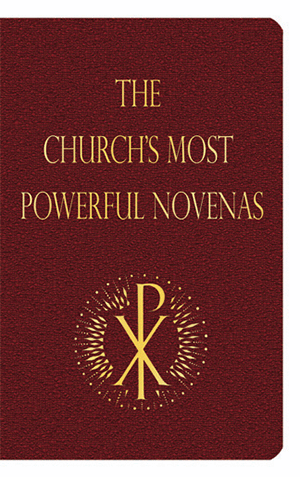
From The Church's Most Powerful NovenasRita Lotti was born near Cascia in Italy in the fourteenth century, the only child of her parents, Antonio and Amata. Her parents were official peacemakers in a turbulent environment of feuding families.
At an early age Rita felt called to religious life; however, her parents arranged for her to be married to Paolo Mancini. Rita accepted this as God’s will for her, and the newlyweds were soon blessed with two sons.
One day while on his way home, Paolo was killed. Rita’s grief was compounded with the fear that her two sons would seek to avenge their father’s death, as was the custom of the time. She began praying and fasting that God would not allow this to happen. Both sons soon fell ill and died, which Rita saw as an answer to her prayers.
Now alone in the world, Rita sought to enter religious life, feeling that God had cleared the path for her to fulfill the vocation that she had felt was hers from childhood. Yet she found that the convent she so desired to enter was reluctant to accept her due to fears that the political rivals that had killed her husband would bring violence on them.
She finally brought peace between the rivals and was able to enter the Convent of St. Mary Magdalene of the Augustinian Nuns. In religious life, Rita was noted for her holiness. She spent her days not only in prayer and contemplation but also in service to the sick and the poor.
One day while kneeling in prayer and contemplating the passion of Jesus, she received the wound of one thorn from the crown of thorns that she bore until her death some fifteen years later.
Devotion to St. Rita was almost nonexistent for five hundred years, but with her canonization in 1900, all of that has changed. She is truly a saint for every state in life, having spent her life as a married woman, a mother, a widow, and a religious.
Sunday, May 21, 2017
Easter Season Meditation by Michael Dubruiel
St. Peter Chrysologus (the “golden-worded”) was known forhis clear and simple style of preaching. About the angel’s appearanceat the tomb, he preached, “Pray that the angel woulddescend now and roll away all the hardness of our hearts andopen up our closed senses and declare to our minds that Christhas risen, for just as the heart in which Christ lives and reigns isheaven, so also in the heart in which Christ remains dead andburied is a grave.”
For those who do not believe, life unfolds as a series of accidents.When a follower of Christ sees his life in exactly the sameway, Jesus calls that person foolish, slow to believe. Someone likethat needs to redirect his attention to the cross.
Saturday, May 20, 2017
73 Steps to Communion with God
Here is the first posting of a series that Michael Dubruiel wrote entitled 73 Steps to Spiritual Communion with God. These steps are drawn from Saint Benedict's Rule, the reflections are his own. Originally published in 2003.
This is step one:
(1) In the first place to love the Lord God with the whole heart, the whole soul, the whole strength...
Benedict begins what will be a list of simple practices with one that is above all others, the practice of a complete love of God. A love that is one that desires only God, symbolized by the heart; a love that meditates only on God symbolized by the soul; and a love that focuses all of its energy on exhibiting this love of God symbolized by my strength.
If we are honest, this is exactly what we all fear the most, an unconditional surrender of all to God.
I remember when I taught high school theology at a Jesuit School the response that I would always receive from my students whenever I would present to them Saint Ignatius’ First Principle and Foundation which teaches that the purpose of our lives is to know, love and serve God and that everything else is secondary and is here to help us attain that purpose. Most of the Catholic students would become outraged, usually a few non-Catholic students in some cases nonbelievers would say it made perfect sense to them.
The issue of acceptance of this foundational attitude in spirituality is one of trust. Do we trust that God wants what is best for us. In our fears is an agenda that thinks that God will only get in the way of our happiness. Unfortunately it takes a long time for most of us to realize that what we think we want changes almost hourly.
We need direction in our lives. Our lives need to be oriented in some direction. The question is where will we seek that guidance?
The map pocket of my car is full of maps. The maps are only helpful to me if I know what my ultimate destination is and if I know where I am at the present moment. Recently while driving in a strange city with the map opened to that city, I knew where I wanted to go but had no idea where I was. Someone in the neighborhood I was in had torn down all of the street signs. I continued to travel up the street until finally I was able to locate a street sign.
Our lives can be the same confused mess that I felt on that day driving aimlessly up and down a city street. Who are we? Why are we here?
The Baltimore Catechism gave us a simple answer. We are here because God loves us. That is the starting point of the spiritual quest is to believe wholeheartedly that we are loved. A subtle but key ingredient to the fear that we feel in surrendering to God is that we do not believe that we are loved but fear that we are hated.
I remember as a child whenever I would be on my way to confession on a Saturday afternoon secretly fearing that God would try to see to it that I was killed before I arrived there. Where this fear came from I do not know, but it was real and it was only much later that I finally realized that God was the redeemer not the enemy.
The attitude we have toward God is all-important if we are to love God with our whole being. We must believe that God loves us first and want what is best for us. It is hard to do anything but love God with our whole being if we believe that God loves us. In an older translation of the New American Bible the words of Jesus are applicable here, “Fear is useless, what is needed is trust.” The words of the supplicant must be our words also, “I believe Lord, help my unbelief.”
It may seem obvious that the first step that anyone would make toward perfect communion with God is to place God at the very center, but how many times we look everywhere else for the way? If we wish to have communion with God we must enter into God’s presence and offer our entire being to God.
Most of us have given the allegiance of part of our being to God but not the whole. I can say that intellectually I have always believed in God and placed my soul in varying degrees to the love of God, but my heart well that is another story. There have been countless times that what my heart has desired has been anything but God. I have thought that this or that would make me truly happy and I have gone down many paths ignoring God in the process.
If I believe that God has created me and knows me best and what is in my ultimate interest, I will seek God above all things.
I still remember the first time I encountered the simple engraving over the entrance of the Monastery of Our Lady of Gethsemane in Kentucky. I stood there for some time looking at the simple words etched in stone that seemed bigger than life, “GOD ALONE.” There was something shocking about the simplicity of the statement, but at the same time a truth that touched me deeply.
In the end when our life is failing nothing else will matter. If we can acknowledge that at this point why not see the wisdom of putting God first in everything today? The message of Benedict’s first step is to put God first in all things and to do so lovingly.
Friday, May 19, 2017
The Pocket Guide to the Mass
The Gospel readings at Mass during this time are focusing on the Eucharist via John, chapter 6. Why not follow the Church's lead and learn more about the Mass during this time?From Michael Dubruiel, in 2007:
I have written a lot about the Mass--without ever really intending to do so. First, I wrote about the Mass in The How-To Book of the Mass: Everything You Need to Know but No One Ever Taught You
Thursday, May 18, 2017
Tuesday, May 16, 2017
Pray the Rosary in May - Mary's Month
Michael Dubruiel conceived and put together the small hardbound book, Praying the Rosary. Click on the cover for more information.
. 
The Gospels show that the gaze of Mary varied depending upon the circumstances of life. So it will be with us. Each time we pick up the holy beads to recite the Rosary, our gaze at the mystery of Christ will differ depending on where we find ourselves at that moment.
Thereafter Mary’s gaze, ever filled with adoration and wonder, would never leave him. At times it would be a questioning look, as in the episode of the finding in the Temple: “Son, why have you treated us so?” (Lk 2:48); it would always be a penetrating gaze, one capable of deeply understanding Jesus, even to the point of perceiving his hidden feelings and anticipating his decisions, as at Cana (cf. Jn 2:5). At other times it would be a look of sorrow, especially beneath the Cross, where her vision would still be that of mother giving birth, for Mary not only shared the passion and death of her Son, she also received the new son given to her in the beloved disciple (cf. Jn 19:26-27). On the morning of Easter hers would be a gaze radiant with the joy of the Resurrection, and finally, on the day of Pentecost, a gaze afire with the outpouring of the Spirit (cf. Acts 1:14) [Rosarium Virginis Mariae, no. 10].
As we pray the Rosary, then, we join with Mary in contemplating Christ. With her, we remember Christ, we proclaim Him, we learn from Him, and, most importantly, as we raise our voices in prayer and our hearts in contemplation of the holy mysteries, this “compendium of the Gospel” itself, we are conformed to Him.
Monday, May 15, 2017
Easter Season Reflection by Michael Dubruiel
Coming to the tomb of Jesus that first Easter morning, the
women discovered an angel there, the rock rolled away. It was a
shocking and unexpected sight. The guards, who were there to
This is the power of
the cross for the follower
of Christ, no matter
what happens to us or can
happen to us we are not
defeated.
make sure that the disciples did not steal the body of the Lord,
were also witnesses to this. They were overcome with fear—to the
point of being “like dead men.”
One experience, two groups of people, two different reactions.
One group looks at the empty tomb and rushes to tell what
they have witnessed. The other group is paralyzed by the life
event. This wasn’t just something that happened thousands of
years ago; it happens every moment of every day. Those who see
the cross as the end of their life, meet death there; those who
believe and place their trust in God, find in the cross life and victory.
Subscribe to:
Comments (Atom)