Today is another Marian feast - the Queenship of Mary. It's also one of the mysteries of the Rosary, and so it's appropriate to talk about the Rosary as we contemplate the feast. Michael Dubruiel conceived and put together the small hardbound book, Praying the Rosary. Click on the cover for more information.
Tuesday, August 22, 2017

Monday, August 21, 2017
73 Steps to Spritual Communion with God - 48
This is a continuation of the 73 Steps to Spritual Communion with God by Michael Dubruiel. The previous posts are in the archives to the right. This is step 48:
(48) To keep a constant watch over the actions of our life.
We read in the Book of Wisdom "To fix one's thought on her is perfect understanding, and he who is vigilant on her account will soon be free from care", (Wisdom 6:15). Vigilance is a hallmark of monastic life, it is why silence has always been valued in that setting.
Vigilance requires attentiveness. Everyone has had the experience where they arrive home after driving the daily route only to discover that they remember nothing about the trip they have just made presumably awake. Much of life can become so routine that we are oblivious to those around us.
Monks have a practice of keeping "vigil." I once tried something similar when I attended school at a monastery. I decided that I would simply spend the night with Jesus in the Blessed Sacrament. I took along a Bible, a rosary and sat in a small oratory. Just the Lord and me. The time passed rather quickly. There were no great revelations during that period of prayer, but what I did notice was that during the next few days everything seemed more intense. It was almost as though the world was suddenly in "high definition" vs. the black and white that it usually seems to be.
Unfortunately, for me it was a one time event. But I have noticed that the more I pray, the more vigilant I become. The more I notice others that cross my path. The less I travel through my day on automatic pilot.
Most of us might raise the excuse of there being too many distractions in life for us to be truly vigilant. But therein lies the distinction--distractions demand our attention. What we call distractions are things that we are ignoring that are clamoring for our attention. The vigilant persons pays attention to everything they are doing and thinking.
The image of a psychic who seems to see and hear voices that no one else hears seems an apt representation of the vigilant person. All of us carry with us intense memories of past experiences, these play a heavy role in the way we act toward others. The vigilant person will discern the "other" people in the room so to speak when they encounter their daily contacts.
(48) To keep a constant watch over the actions of our life.
We read in the Book of Wisdom "To fix one's thought on her is perfect understanding, and he who is vigilant on her account will soon be free from care", (Wisdom 6:15). Vigilance is a hallmark of monastic life, it is why silence has always been valued in that setting.
Vigilance requires attentiveness. Everyone has had the experience where they arrive home after driving the daily route only to discover that they remember nothing about the trip they have just made presumably awake. Much of life can become so routine that we are oblivious to those around us.
Monks have a practice of keeping "vigil." I once tried something similar when I attended school at a monastery. I decided that I would simply spend the night with Jesus in the Blessed Sacrament. I took along a Bible, a rosary and sat in a small oratory. Just the Lord and me. The time passed rather quickly. There were no great revelations during that period of prayer, but what I did notice was that during the next few days everything seemed more intense. It was almost as though the world was suddenly in "high definition" vs. the black and white that it usually seems to be.
Unfortunately, for me it was a one time event. But I have noticed that the more I pray, the more vigilant I become. The more I notice others that cross my path. The less I travel through my day on automatic pilot.
Most of us might raise the excuse of there being too many distractions in life for us to be truly vigilant. But therein lies the distinction--distractions demand our attention. What we call distractions are things that we are ignoring that are clamoring for our attention. The vigilant persons pays attention to everything they are doing and thinking.
The image of a psychic who seems to see and hear voices that no one else hears seems an apt representation of the vigilant person. All of us carry with us intense memories of past experiences, these play a heavy role in the way we act toward others. The vigilant person will discern the "other" people in the room so to speak when they encounter their daily contacts.
Prayer and discernment are both necessary to be truly vigilant in our actions. We need to truly see what creates our reactions to people and events and bring them to God. To free ourselves from inordinate attachments. As the Book of Wisdom says to be vigilant will "free us from all care." No regrets, only gratitude.


Sunday, August 20, 2017
73 Steps to Spritual Communion with God - 47
This is a continuation of the 73 Steps to Spritual Communion with God by Michael Dubruiel. The previous posts are in the archives to the right. This is step 47:
(47) To keep death before one's eyes daily.
Momento Mori, "remember death" is an ancient spiritual maxim presented to us here by St. Benedict. Keeping one's end in mind helps us to focus on what really matters. Many self-motivators have picked up on this and while avoiding "death" have sought to get people to meditate on what is really important in life.
Of course what happens after death matters a great deal if we are to focus on death. If one believes that nothing happens after death that focusing on it could be a morose practice that would only depress the person. If on the other hand one believes in the after life and a judgment then every decision I make in the present is moving me along a road in one of two directions--either toward heaven or hell.
Many people believe in a after life for absolutely no good reason. Many of them do not believe in God, but reaping the harvest of Christendom continue to carry around with them a vague sense that death is not the end. But this belief does not come from science.
Others, nihilists, belief in nothing but the present but in a rather dark manner, since death is the end that the whole of life is rather meaningless and existence is a bore.
Then there are the Epicureans who "eat, drink and are merry" for tomorrow we die. Their focus is on death, but it is one where death is looked at as the great enemy that must be avoided at all costs by throwing as much pleasure as possible at the body while it is still alive. These are the saddest of people. Often their bodies are racked with pain from the abuse that they have subjected it to in pursuit of pleasure.
The final group is made up of believers. Our focus on death is to be hopeful. It is to help us to get through the present moment when it is difficult. It is to inspire us in the present moment when it seems meaningless. It is to keep our eyes on the gift that sin promises-death and the redemption that God through Jesus promises-life.
(47) To keep death before one's eyes daily.
Momento Mori, "remember death" is an ancient spiritual maxim presented to us here by St. Benedict. Keeping one's end in mind helps us to focus on what really matters. Many self-motivators have picked up on this and while avoiding "death" have sought to get people to meditate on what is really important in life.
Of course what happens after death matters a great deal if we are to focus on death. If one believes that nothing happens after death that focusing on it could be a morose practice that would only depress the person. If on the other hand one believes in the after life and a judgment then every decision I make in the present is moving me along a road in one of two directions--either toward heaven or hell.
Many people believe in a after life for absolutely no good reason. Many of them do not believe in God, but reaping the harvest of Christendom continue to carry around with them a vague sense that death is not the end. But this belief does not come from science.
Others, nihilists, belief in nothing but the present but in a rather dark manner, since death is the end that the whole of life is rather meaningless and existence is a bore.
Then there are the Epicureans who "eat, drink and are merry" for tomorrow we die. Their focus is on death, but it is one where death is looked at as the great enemy that must be avoided at all costs by throwing as much pleasure as possible at the body while it is still alive. These are the saddest of people. Often their bodies are racked with pain from the abuse that they have subjected it to in pursuit of pleasure.
The final group is made up of believers. Our focus on death is to be hopeful. It is to help us to get through the present moment when it is difficult. It is to inspire us in the present moment when it seems meaningless. It is to keep our eyes on the gift that sin promises-death and the redemption that God through Jesus promises-life.
This focus is one of reality. We are all going to die. By facing it daily it will not catch us unprepared nor unready for God's judgment.
Friday, August 18, 2017
How to Receive Communion at a Catholic Mass
An excerpt from The How to Book of the Mass by Michael Dubruiel
When our Lord gave the disciples on the road to Emmaus the bread that He had blessed and broken, "he vanished out of their sight" (Luke 24:31). It was then that they recognized Him. We receive the Lord as they did in receiving the Eucharist. Now, at the moment that He is within us, we too should reflect, as they did, on the Scriptures that He has opened to us during this Mass, especially on what has made our "hearts burn."
In our consumer-minded society, we can miss the treasure that we receive if we treat it like one more thing to "get" and then go on to the next thing. Our Lord is not a "thing." He is God, who has deigned to come intimately into our lives. We should reflect on His Presence within us and ask what He would have us do.
More on The How to Book of the Mass here.

Thursday, August 17, 2017
A Brief Guide to the Catholic Mass Michael Dubruiel
 The Gospel readings at Mass during this time are focusing on the Eucharist via John, chapter 6. Why not follow the Church's lead and learn more about the Mass during this time?
From Michael Dubruiel, in 2007:
I have written a lot about the Mass--without ever really intending to do so. First, I wrote about the Mass in The How-To Book of the Mass: Everything You Need to Know but No One Ever Taught You
 --this book has done so well that I was asked to write a follow-up to it. That book How To Get The Most Out Of The Eucharist
 , probably should have been titled "How to Offer Your Sacrifice at Every Mass." Then this year, A Pocket Guide to the Mass
 , which is part of the "A Pocket Guide" series. Each book is different and offers a slightly different way to open oneself up to the riches that are being bestowed upon us by fulfilling the Lord's command to "Do this." Thanks to everyone who has read any of the three and offered very positive reviews of them.
Wednesday, August 16, 2017
RCIA Resource on Confession
Many people are looking for resources for RCIA this time of year. If you are looking for a good introduction to the Sacrament of Reconciliation, try this:
For a brief, pointed and helpful guide,

All of Michael Dubruiel's books listed on Amazon.
The Power of the Cross free download and audio files.
The New Version of the Stations of the Cross link
For a brief, pointed and helpful guide,
All of Michael Dubruiel's books listed on Amazon.
The Power of the Cross free download and audio files.
The New Version of the Stations of the Cross link
Tuesday, August 15, 2017
Feast of the Assumption - August 15
The Feast of the Assumption is today, August 15. The Assumption is, of course, one of the mysteries of the Rosary, and so it's appropriate to talk about the Rosary as we contemplate the feast. Michael Dubruiel conceived and put together the small hardbound book, Praying the Rosary. Click on the cover for more information.
Monday, August 14, 2017
St. Maximillian Kolbe - August 14
Today is the Feast of St. Maximillian Kolbe
From a letter he wrote, from theOffice of Readings:
It is sad to see how in our times the disease called “indifferentism” is spreading in all its forms, not just among those in the world but also among the members of religious orders. But indeed, since God is worthy of infinite glory, it is our first and most pressing duty to give him such glory as we, in our weakness, can manage – even that we would never, poor exiled creatures that we are, be able to render him such glory as he truly deserves.
Books by Michael Dubruiel
From a letter he wrote, from theOffice of Readings:
It is sad to see how in our times the disease called “indifferentism” is spreading in all its forms, not just among those in the world but also among the members of religious orders. But indeed, since God is worthy of infinite glory, it is our first and most pressing duty to give him such glory as we, in our weakness, can manage – even that we would never, poor exiled creatures that we are, be able to render him such glory as he truly deserves.
Books by Michael Dubruiel
Friday, August 11, 2017
73 Steps to Spritual Communion with God - 46 by Michael Dubruiel
This is a continuation of the 73 Steps to Spritual Communion with God by Michael Dubruiel. The previous posts are in the archives to the right. This is step 46:
(46) To desire eternal life with all spiritual longing.
I think that this is one of those maxims that would have been a given in previous ages. But now it seems that no one is brought up with a great "desire" for eternal life with all spiritual longing.
I remember as a child listening to a visiting priest preach about the importance of eternity in light of the present moment. It left a deep impression on my young mind and from that day forward every action that I undertook was charged with "eternal" implications.
The type of "longing" that St. Benedict counsels us to have is "spiritual" longing. This is a little more complicated that the normal type of longing but it is an important distinction. Too often people in the past approached their desire for eternal life with an earthly register--keeping track of their good acts, performing prayers with certain types of indulgences--all with a keen eye on where they were on the spiritual maturity meter. This is all the stuff of this life and a pretty sad indication that one really doesn't trust in God at all.
A spiritual longing is much more focused on God and less on self. St. Paul desired eternal life with this type of longing when he wished if for his fellow men to the point that he himself would forgo it, if it would save them. Spiritual longing is always sacrificial and somewhat paradoxical.
Our Lord said, "I am the vine, you are the branches. Apart from me you can do nothing." There is great wisdom in meditating on these words in light of St. Benedict's maxim to "desire eternity with a spiritual longing." We long to cleave to Christ, to imitate Him and to be united with Him, so to live with Him for all eternity.
(46) To desire eternal life with all spiritual longing.
I think that this is one of those maxims that would have been a given in previous ages. But now it seems that no one is brought up with a great "desire" for eternal life with all spiritual longing.
I remember as a child listening to a visiting priest preach about the importance of eternity in light of the present moment. It left a deep impression on my young mind and from that day forward every action that I undertook was charged with "eternal" implications.
The type of "longing" that St. Benedict counsels us to have is "spiritual" longing. This is a little more complicated that the normal type of longing but it is an important distinction. Too often people in the past approached their desire for eternal life with an earthly register--keeping track of their good acts, performing prayers with certain types of indulgences--all with a keen eye on where they were on the spiritual maturity meter. This is all the stuff of this life and a pretty sad indication that one really doesn't trust in God at all.
A spiritual longing is much more focused on God and less on self. St. Paul desired eternal life with this type of longing when he wished if for his fellow men to the point that he himself would forgo it, if it would save them. Spiritual longing is always sacrificial and somewhat paradoxical.
Our Lord said, "I am the vine, you are the branches. Apart from me you can do nothing." There is great wisdom in meditating on these words in light of St. Benedict's maxim to "desire eternity with a spiritual longing." We long to cleave to Christ, to imitate Him and to be united with Him, so to live with Him for all eternity.
Tuesday, August 08, 2017
Feast of St. Dominic - August 8 by Michael Dubruiel
Today is the Feast of Saint Dominic
From the Office of Readings:
Frequently he made a special personal petition that God would deign to grant him a genuine charity, effective in caring for and obtaining the salvation of men. For he believed that only then would he be truly a member of Christ, when he had given himself totally for the salvation of men, just as the Lord Jesus, the Saviour of all, had offered himself completely for our salvation. So, for this work, after a lengthy period of careful and provident planning, he founded the Order of Friars Preachers.
In his conversations and letters he often urged the brothers of the Order to study constantly the Old and New Testaments. He always carried with him the gospel according to Matthew and the epistles of Paul, and so well did he study them that he almost knew them from memory.
Two or three times he was chosen bishop, but he always refused, preferring to live with his brothers in poverty. Throughout his life, he preserved the honour of his virginity. He desired to be scourged and cut to pieces, and so die for the faith of Christ. Of him Pope Gregory IX declared: “I knew him as a steadfast follower of the apostolic way of life. There is no doubt that he is in heaven, sharing in the glory of the apostles themselves”.
Books by Michael Dubruiel
From the Office of Readings:
Frequently he made a special personal petition that God would deign to grant him a genuine charity, effective in caring for and obtaining the salvation of men. For he believed that only then would he be truly a member of Christ, when he had given himself totally for the salvation of men, just as the Lord Jesus, the Saviour of all, had offered himself completely for our salvation. So, for this work, after a lengthy period of careful and provident planning, he founded the Order of Friars Preachers.
In his conversations and letters he often urged the brothers of the Order to study constantly the Old and New Testaments. He always carried with him the gospel according to Matthew and the epistles of Paul, and so well did he study them that he almost knew them from memory.
Two or three times he was chosen bishop, but he always refused, preferring to live with his brothers in poverty. Throughout his life, he preserved the honour of his virginity. He desired to be scourged and cut to pieces, and so die for the faith of Christ. Of him Pope Gregory IX declared: “I knew him as a steadfast follower of the apostolic way of life. There is no doubt that he is in heaven, sharing in the glory of the apostles themselves”.
Books by Michael Dubruiel
Monday, August 07, 2017
RCIA Resource
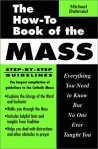
In this complete guide you get:
- step-by-step guidelines to walk you through the Mass
- the Biblical roots of the various parts of the Mass and the very prayers themselves
- helpful hints and insights from the Tradition of the Church
- aids in overcoming distractions at Mass
- ways to make every Mass a way to grow in your relationship with Jesus
- Bless yourself
- Make the Sign of the Cross
- Genuflect
- Pray before Mass
- Join in Singing the Opening Hymn
- Be penitential
- Listen to the Scriptures
- Hear a Great Homily Everytime
- Intercede for others
- Be a Good Steward
- Give Thanks to God
- Give the Sign of Peace
- Receive the Eucharist
- Receive a Blessing
- Evangelize Others
- Get something Out of Every Mass You Attend
Find more about The How to Book of the Mass here.
More about Michael Dubruiel here.
Sunday, August 06, 2017
The Transfiguration - August 6
From Pope Benedict's Angelus:
Books by Michael Dubruiel
“On the transfigured face of Jesus shone a ray of the divine light that He guarded within. This very light radiates on the face of Christ on the day of the Resurrection. Thus, the Transfiguration is like an anticipation of the Paschal mystery... The... Resurrection overcame once and for all the power of the shadow of evil. With the risen Christ, truth and love triumph over deceit and sin. In Him, the light of God now illuminates the life of men and the path of history permanently. ‘I am the light of the world,’ He says in the Gospel. ‘Whoever follows me will never walk in darkness but will have the light of life.’ (Jn 8:12).”
Books by Michael Dubruiel
Saturday, August 05, 2017
Fulton Sheen Book
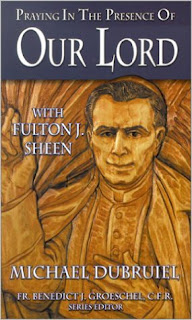
Praying in the Presence of Our Lord with Fulton J. Sheen by Michael Dubruiel
This is an excerpt from one of my books, "Praying in the Presence of Our Lord with Fulton J. Sheen". This entry is from Part I under the heading "The Sanctification of the Present Moment." I quote this because I noticed somewhere online today the popularity of a spiritual guru who Oprah is promoting, Eckhart Tolle (I think it helps to have an estoteric name in the modern world) who's "Power of Now" is quite the rave. There is nothing new in what Tolle is promoting and any serious student of spirituality can find it in Catholicism. Fulton Sheen was preaching this years ago and as I point out in this entry from the book a very famous work of Christian Spirituality also does:
Bishop Sheen’s “Now-moment” corresponds to the thinking of the great spiritual writer Jean Pierre de Caussade. In Abandonment to Divine Providence, Fr. Caussade gives the reader a sure way of knowing the will of God at any moment—by simply confronting the present moment with all its reality. It seems simple, but if we reflect for a second most of us will find that we spend most of our lives avoiding the present moment.
A few years ago an English translation of the Father Caussade’s work appeared in the United States changing the original title to read “The Sacrament of the Present Moment.” This captures the essence of Father Caussade’s work and Bishop Sheen’s meditation that in the present time we are presented with an opportunity that is truly unique. Each moment is sacramental.
Most of us are capable of presenting ourselves with some amount of reflection as we celebrate the sacraments. If we celebrated the sacrament of Baptism as an adult certainly we came expecting to be changed by God. Each time we enter a confessional surely we have examined our conscience beforehand and are penitent expecting to be forgiven by God. Undoubtedly every time we approach the altar to receive the Eucharist we expect to encounter God. But what about the other moments of our lives?
As we awake in the morning, is our first thought of God? As we greet our brothers and sisters throughout the day do we expect that God might be present? Every moment of our lives is an opportunity to encounter God who is always present.
Spend some time reflecting on the following:
1. Go over the events of the present day and ask yourself where God might have been in each of them. Is there a consistent pattern to your day?
2. Reflect on the life of your favorite saint, and meditate on how he or she dealt with the people they met in their daily journeys. How could you imitate this saint? What enabled the saint to act in the way he or she did toward others?
3. Imagine as you leave from this time of prayer that God wishes to continue to be present to you as you go forth. How will you react to his presence in others?
Prayer
Lord, help me to search for you in the garden of life in the same way that St. Mary Magdalene did when she found your tomb empty. May my search be rewarded as hers was by knowledge of your abiding presence.
Amen.
This is an excerpt from one of my books, "Praying in the Presence of Our Lord with Fulton J. Sheen". This entry is from Part I under the heading "The Sanctification of the Present Moment." I quote this because I noticed somewhere online today the popularity of a spiritual guru who Oprah is promoting, Eckhart Tolle (I think it helps to have an estoteric name in the modern world) who's "Power of Now" is quite the rave. There is nothing new in what Tolle is promoting and any serious student of spirituality can find it in Catholicism. Fulton Sheen was preaching this years ago and as I point out in this entry from the book a very famous work of Christian Spirituality also does:
Bishop Sheen’s “Now-moment” corresponds to the thinking of the great spiritual writer Jean Pierre de Caussade. In Abandonment to Divine Providence, Fr. Caussade gives the reader a sure way of knowing the will of God at any moment—by simply confronting the present moment with all its reality. It seems simple, but if we reflect for a second most of us will find that we spend most of our lives avoiding the present moment.
A few years ago an English translation of the Father Caussade’s work appeared in the United States changing the original title to read “The Sacrament of the Present Moment.” This captures the essence of Father Caussade’s work and Bishop Sheen’s meditation that in the present time we are presented with an opportunity that is truly unique. Each moment is sacramental.
Most of us are capable of presenting ourselves with some amount of reflection as we celebrate the sacraments. If we celebrated the sacrament of Baptism as an adult certainly we came expecting to be changed by God. Each time we enter a confessional surely we have examined our conscience beforehand and are penitent expecting to be forgiven by God. Undoubtedly every time we approach the altar to receive the Eucharist we expect to encounter God. But what about the other moments of our lives?
As we awake in the morning, is our first thought of God? As we greet our brothers and sisters throughout the day do we expect that God might be present? Every moment of our lives is an opportunity to encounter God who is always present.
Spend some time reflecting on the following:
1. Go over the events of the present day and ask yourself where God might have been in each of them. Is there a consistent pattern to your day?
2. Reflect on the life of your favorite saint, and meditate on how he or she dealt with the people they met in their daily journeys. How could you imitate this saint? What enabled the saint to act in the way he or she did toward others?
3. Imagine as you leave from this time of prayer that God wishes to continue to be present to you as you go forth. How will you react to his presence in others?
Prayer
Lord, help me to search for you in the garden of life in the same way that St. Mary Magdalene did when she found your tomb empty. May my search be rewarded as hers was by knowledge of your abiding presence.
Amen.

Subscribe to:
Comments (Atom)
