Michael eating, my sister Ann talking to Amy (those are her reading glasses suspended in the air), Ann's daughter Alex kissing her mom.
Joshua and Joseph discuss super heroes.


“Why did he do it? Why did God become man?”
The chant the angels began singing in the grotto—“Glory to God in the highest and on earth peace to those on whom his favour rests” (Lk 2, 14)—can help answer this question. The canticle of the night before Christmas, which is now in the Gloria, belongs to the liturgy as do the other three canticles from the New Testament which refer to Jesus’ birth and infancy: the Benedictus, the Magnificat and the Nunc dimittis.
Whilst these are included respectively in the morning Lauds, the evening Vesper prayer, and the nightly Compline, the Gloria found its place in the Holy Mass. To the angels’ words a few acclamations were added: "We praise You. We bless You. We adore You. We glorify You. We give You thanks for Your great Glory.” Later “Lord God, Lamb of God, Son of the Father. You who take away the sins of the world, have mercy on us” were added to form an ariose hymn of praise that was sung the first time during Christmas mass and then in all feast days. Included at the beginning of the Eucharistic celebration, the Gloria underscores the existing continuity between and the birth and the death of Christ, between Christmas and Easter, which are indissoluble aspects of the one and the same mystery of salvation.
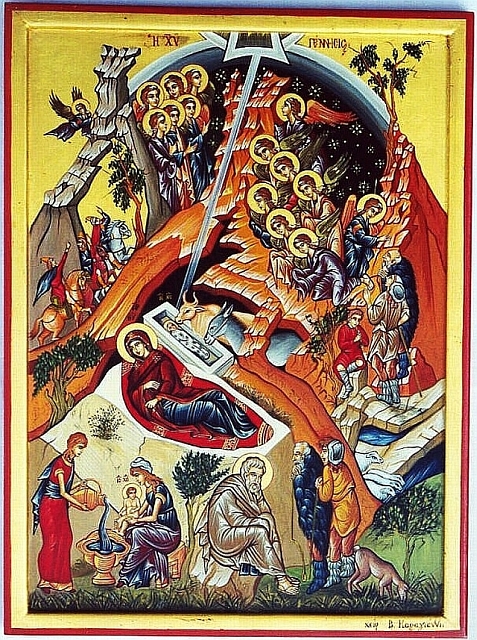
The Gospel says that the angelic multitude sang: “Glory to God in the highest, and on earth peace to people of good will”. The angels announced that the birth of Christ to the shepherds “is” glory to God in the Highest and peace to His people on earth. Therefore, these angelic words are conveniently placed on the grotto to explain the mystery of Christmas that is fulfilled in the nativity scene. The word “gloria” (doxa) indicates the splendour of God that his grateful creatures’ praise elicits. Paul said that it is “the knowledge of the glory of God on the face of (Jesus) Christ” (2 Cor 4, 6). “Peace" (eirene) summarise the fullness of the messianic gift, salvation, as the Apostle puts it, which is identified with Christ himself. “For he is our peace," (Eph 2, 14). There is, finally, a reference to men “of good will”. “Good will” (eudokia) would ordinarily make one think of men’s “good will”, but here it refers to God’s, boundless, “good will” towards men. Hence the Christmas message means that with the birth of Jesus, God has shown his good will towards all.
Let us get back to question “Why did God become man?” St Irenaeus said: “The word became the dispenser of the paternal grace for the benefit of men [. . .]. For the glory of God is a living man—vivens homo—; and the life of man consists in beholding God.” (Adv. Haer. IV, 20, 5.7).
God’s glory manifests itself in the salvation of man whom God loved so much, wrote John the Evangelist, “that he gave his only Son, so that everyone who believes in him might not perish but might have eternal life,” (Jn 3, 16). Love is therefore the ultimate reason for Christ’s incarnation. Theologian H.U. von Balthasar’s reflection on the matter is eloquent. He wrote that “God is not, first of all, absolute power, but rather absolute love whose sovereignty does not manifest itself in keeping what is his, but in giving it up” (Mysterium paschale I, 4). The God that we see in the nativity scene is God-Love.
At this point the angels’ announcement sounds to us like an invitation: “Let there be” glory to God in the Highest, “let there be” peace to His people on earth”. The only way to glorify God and build peace on earth lies in humbly and trustingly welcome the gift of Christmas: love. The angels’ song can then become a prayer to repeat often, not only during the Christmas period. A hymn of praise to God in the highest and a fervent invocation of peace on earth that may turn into a concrete commitment to build it with our own life. This is the commitment Christmas gives us.
Praying the Angelus December 26th on the Feast of St. Stephen Martyr, Pope Benedict XVI spoke of the many Christians who are still suffering persecution in
today’s world and commended them to the care of Mary.
The Pontiff pointed out how the celebration of the Feast of the martyr St. Stephen on the day after Christmas, “can surprise us, because it strikes the contrast between the peace and joy of Bethlehem and the drama of Stephen, stoned to death in Jerusalem in the first persecution against the newly born Church.”The Pope also noted that, “St. Stephen was the first to follow the footsteps of Christ with martyrdom; dying like the Divine Teacher, forgiving and praying for his executioners (cf Acts 7,60).”Moreover, he explained that during the first four centuries of the Church, when all of the Saints were martyrs, “their deaths were not instilled with fear or sadness, but with a spiritual enthusiasm which is always aroused in new Christians.”“For believers, the day of death, and even more so the day of martyrdom, is not the end of everything, but the “passing” into immortal life,
it is the day of their final birth, in Latin “dies natalis.”“We can understand
then, the link which exists between the ‘dies natalis’ of Christ and the ‘dies
natalis’ of St. Stephen. If Jesus was not born on earth, mankind would not be
able to be born in heaven. Because Christ is born, we are able to be “reborn!”
exclaimed the Holy Father.In conclusion the Pontiff entrusted to Mary “the many
who are persecuted and suffering, in various ways, for their testimony and
service to the Gospel.”
A whopping 85 percent of U.S. dioceses have detected embezzlement over the past five years, according to Villanova University researchers. “No question
about it, it’s a large number,” said Charles Zech, director of the school’s
Center for the Study of Church Management and coauthor of the 15-page paper,
“Internal Financial Controls in the U.S. Catholic Church,” that details the
findings. Supported by a grant from the Louisville Institute, Zech and Villanova
accounting professor Robert West surveyed 174 diocesan chief financial officers.
Seventy-eight responded.
The researchers don’t put a precise dollar figure on how much was embezzled, but the range indicates it’s significant. In 11 percent of the dioceses at least $500,000 was stolen over the last five years (meaning that a minimum of $4.3 million went missing) while one-third of the dioceses reported thefts of under $50,000. “You can only wonder about those [96] dioceses that didn’t respond to our survey,” said Zech.
Dishonest church employees and volunteers are the immediate cause, but the heart of the problem lies elsewhere, say the researchers.
“Unlike corporations which provide quarterly financial statements to the SEC and hold quarterly conference calls with outside analysts, the church is subject to almost no recurring outside financial scrutiny,” according to the report. Further, while “many dioceses provide parishioners with an annual financial and administrative newsletter,which provides a highly summarized view of the cash flows for the year and the results of social and spiritual programs offered by the diocese -- many other dioceses do neither.”
While external oversight of diocesan and parish finances is virtually nonexistent, internal checks are hardly any better. “Only 3 percent of the dioceses conducted an annual internal audit of their parishes,”while “21 percent of the dioceses indicated that they seldom or never audit their parishes.” When such reviews do occur, the researchers say, it’s frequently because a pastor or bookkeeper has ceased working in the parish.

"Today many consider God irrelevant. Even believers sometimes seek tempting but illusory shortcuts to happiness. And yet perhaps even because of this confusion humanity seeks a savior, and awaits the coming of Christ," the pope said.
Although he warned against being distracted by what he called the "trappings of Christmas," Benedict offered thanks for the 33-meter (110-foot) Christmas tree set up in St. Peter's Square, and the one in his private apartment in the Vatican, both gifts from the mountains of Calabria in southern Italy.
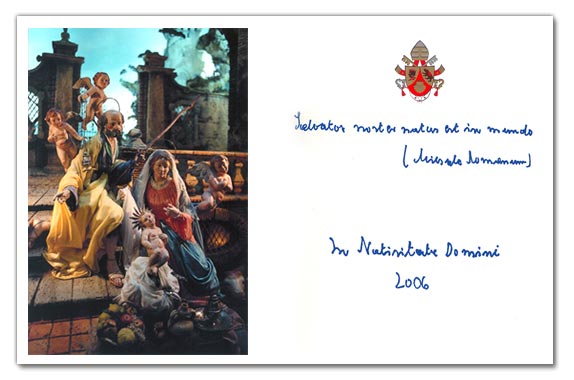
He also encouraged the custom of setting up nativity scenes in the home.
"It is my hope that such an important element (of Christmas) not only part of our spirituality, but also of our culture and art continue to be a simple and eloquent way of remembering Christ."
As I waited for Mother Angelica to come through the door, I saw that the man standing
next to me had a gun.
It was just fifteen minutes before Mother and I were scheduled to spend an hour together on Mother Angelica Live!
They'd dusted my face with makeup and led me into the cramped corridor that connected Mother's monastery to the EWTN studio. The guard looked me up and down
and then stared right into my face.
"Why do you have a gun here?" I asked.
"These days, you can't be too careful," he said, relaxing his gaze, but resting his hand on his holster.
Indeed, not a hundred yards from where I stood, thugs had twice shot up the walls of Mother's convent, in a failed attempt to drive her and her nuns out of Birmingham. Mother said that one bullet landed so close to her she "could smell the gunpowder."
And she added with a chuckle: "You never saw a crippled nun run so fast in all your life."
In Raymond Arroyo's wonderful biography of Mother Angelica, Mother notes that: "Some people say I'm a woman of great faith. I'm really a coward who keeps moving forward."
To me, that sounds like courage, not cowardice.And it's courage she's shown for eight decades now despite abandonment, lack of education, bullets, bad bishops,
near-bankruptcy, asthma, injuries, operations, pain, scorn, criticism, and the spiritual bleakness that afflicts many of us who labor these days in the vineyard of the Lord.
That evening, it was a delight to be on live TV with Mother Angelica. Her quick wit, her frank comments, and her frequent laughter enlivened my talk about the Catholic books I've published by St. Thomas Aquinas, St. Francis de Sales, St. Catherine of Genoa, Dietrich von Hildebrand, and other holy men and women.
But she was motherly, too, admonishing her viewers as if they were errant teenagers: "You have to educate your conscience. You have to read and read and read! If you spend fifteen minutes a day reading, your whole life will change. So turn off that TV!"
And then she added mischievously, "Except EWTN, of course!"
During the station break, Mother asked about my work. Hoping to impress her, I said, "I started Sophia Institute Press with $100 and no publishing experience."
"Well how about that!" she responded, unmoved. "I started EWTN with $200 and no broadcasting experience."
Once the cameras were rolling again, Mother said to the audience, "John and I both started with nothing. And we're always asking for funds."
The live audience laughed, but I was embarrassed."That's true," I began slowly, looking at my hands as I sought the right words. "It's unfortunate. I apologize. . . ."
"Oh, don't do that!" Mother shot back loudly. "I don't!"She chortled, and the audience laughed along with her.
An Operative Theology of Exit: Why Catholics Leave
- Lack of active participation
- Lack of scriptural and theological sophistication
- Lack of appropriate and effective Catholic catechesis
- Anemic parishes and preaching

The proclamation of the joy of Christmas, of the coming of the Lord, is directed especially at the “lame of the earth”: those who suffer because they face the tragedy of war, in the Middle East or some places in Africa, or because they are stricken by sickness or solitude, or because, like many of today’s young people, they do not know the true meaning of joy for they have lost themselves in an exaggerated quest for the mirages of consumerism, for moments of intoxication and all forms of alienation. On this day when the liturgy makes a call to joy of the spirit, Benedict XVI urged the faithful to reflect on the true meaning of joy, found not in the myths of our time but in the proclamation of salvation contained in the word of God. The pope remembered especially Iraqi refugees in Syria, “forced to leave their country because of the tragic situation they are experiencing” and he made an appeal on their behalf to “individuals, international organizations and governments” to commit themselves still more “to meet their most urgent needs”.
Today there were many children in the crowd of 40,000 people who took part in the recital of the Angelus in St Peter’s Square, where a Christmas tree has been installed and a crib is being prepared. As per Roman tradition, the children brought ‘baby Jesus’ with them, that is, statuettes of the Child Jesus to place in cribs in parishes, schools and homes, to be blessed by the pope. They noisily welcomed Benedict XVI and responded heartily to his greeting after the Marian prayer. The pope said the call to joy in the antiphon of today’s liturgy, which echoes an exhortation of the apostle Paul, “Gaudete in Domino”, is not directed only at Christians: “It is a prophetic announcement for all humanity, especially for the poorest, in this case, those who are most deprived of joy! Just think about our brothers and sisters who, especially in the Middle East, in some places in Africa and the rest of the world, are experiencing the tragedy of war: how could they experience joy? What will their Christmas be like? Think about sick people and those who are alone, whose soul is tested apart from their physical trials, because they not infrequently feel abandoned: how to share joy with them, without being disrespectful of their pain? But let us think also of those – especially youth – who have lost the meaning of true joy and who vainly search for it in places where it is impossible to find: in an exaggerated quest for self-affirmation and success, in false entertainment, consumerism, moments of intoxication, artificial paradises of drugs and all forms of alienation. We cannot but contrast today’s liturgy of ‘Rejoice!’ with these tragic realities. As in the times of the prophet Zephaniah, the Word of the Lord addresses in a special way those who are undergoing trials, the ‘lame of the earth and orphans of joy’. The invitation to joy is not an alienating message or a sterile palliative; on the contrary, it is a prophecy of salvation, an appeal to redemption that starts with internal renewal.”
The pope continued: “To transform the world, God chose a humble maiden from a village in Galilee, Mary of Nazareth, and greeted her thus: ‘Rejoice, full of grace, the Lord is with you.’ The secret of an authentic Christmas lies in these words. God repeats them to the Church, to each one of us: Rejoice, the Lord is near! With the help of Mary, let we offer ourselves with humility and courage so the world may welcome Christ, who is the source of true joy.”
After reciting the Angelus, while greeting the children and youth of Rome, he said: “I bless from my heart all the ‘Baby Jesus’ statues. Dear children, before the crib, pray to Jesus for the intentions of the pope as well! I thank you and wish you a happy Christmas!”